

Can GMRS talk to CB radio? While both are popular two-way radio systems, GMRS and CB radios operate on different frequencies and protocols, making direct communication between them impossible without special equipment. This article breaks down the technical differences, legal aspects, and practical tips to help you understand their compatibility and use.
Contents
- 1 Key Takeaways
- 2 Quick Answers to Common Questions
- 3 📑 Table of Contents
- 4 Introduction
- 5 Understanding GMRS and CB Radio Basics
- 6 Why GMRS Cannot Talk Directly to CB Radio
- 7 Legal and Regulatory Considerations
- 8 Practical Tips for GMRS and CB Radio Users
- 9 Examples of Use Cases
- 10 Conclusion
- 11 Frequently Asked Questions
- 12 Author
Key Takeaways
- Different Frequency Bands: GMRS and CB radios operate on distinct frequency ranges, preventing direct communication.
- Modulation and Channel Differences: GMRS uses FM modulation; CB uses AM, which affects compatibility.
- Licensing Requirements: GMRS requires an FCC license, while CB radio does not.
- Communication Range: GMRS typically offers better range with repeaters compared to CB.
- Bridging Communication: Special equipment or software is needed to connect GMRS and CB radios.
- Use Cases: CB radios are common for trucking and off-road use, GMRS suits family and outdoor communication.
- Legal Compliance: Users must follow FCC rules for each radio type to avoid fines.
Quick Answers to Common Questions
Can GMRS radios communicate on CB channels?
No, GMRS radios cannot communicate on CB channels because they operate on different frequencies and use different modulation methods.
Do you need a license to use GMRS radios?
Yes, the FCC requires a license to operate GMRS radios legally in the United States.
Is a license required for CB radio use?
No, CB radios are license-free for personal use in the U.S., but users must follow FCC power and antenna rules.
Can you extend GMRS radio range?
Yes, GMRS radios can use repeaters to extend their communication range significantly beyond typical handheld distances.
Are there devices to connect GMRS and CB radios?
Yes, some specialized bridging devices or software can link GMRS and CB radios, but these setups require extra equipment and technical know-how.
📑 Table of Contents
Introduction
If you’re exploring two-way radios, you’ve likely come across GMRS and CB radio options. Both are popular for personal and group communication, especially in outdoor and vehicle scenarios. But a common question is: can GMRS talk to CB radio? In other words, if you own a GMRS radio, can you chat with someone using a CB radio and vice versa?
This question often confuses beginners because both radios look similar and serve comparable purposes. However, GMRS (General Mobile Radio Service) and CB (Citizens Band) radios are fundamentally different in how they operate. Understanding these differences will help you choose the right radio and know the limits of communication.
In this article, we’ll dive into the technical aspects, legal considerations, practical examples, and tips for using GMRS and CB radios effectively. By the end, you’ll know exactly why these two systems don’t talk directly and what you can do about it.
Understanding GMRS and CB Radio Basics
What is GMRS?
GMRS stands for General Mobile Radio Service. It operates on frequencies around 462 and 467 MHz in the UHF range. GMRS radios typically use frequency modulation (FM), providing clearer audio quality. GMRS radios often support higher power output and repeater use, which extends communication range significantly.
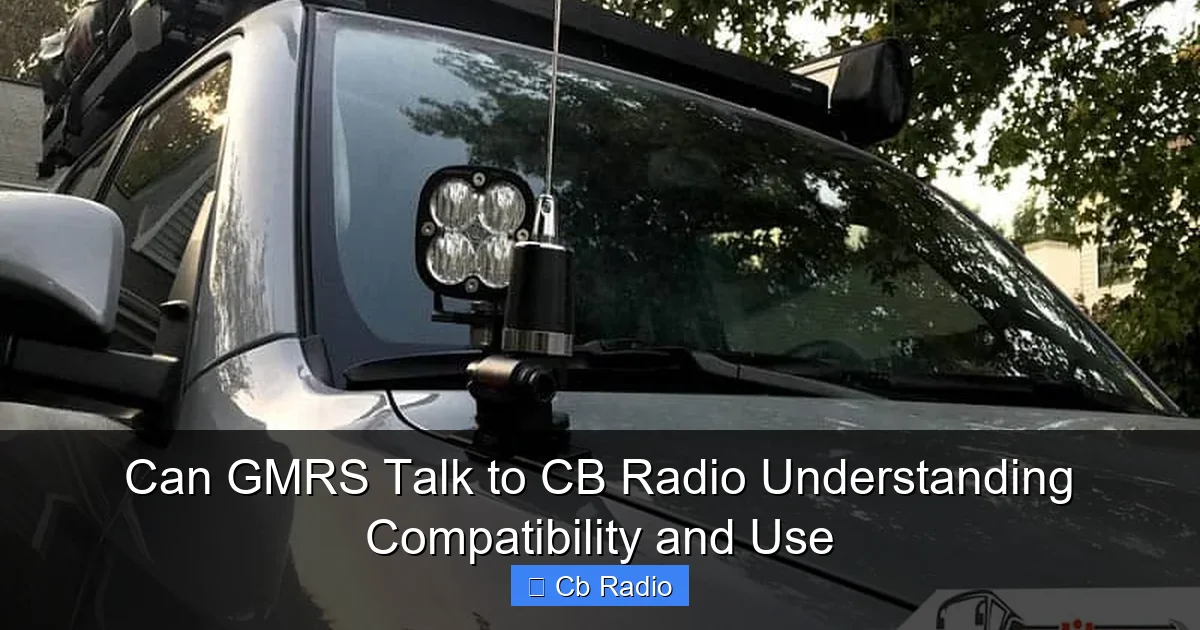
Visual guide about Can GMRS Talk to CB Radio Understanding Compatibility and Use
Image source: rvlibary.com
One important note: using GMRS legally requires an FCC license in the United States. The license covers your entire family and is relatively easy to obtain.
What is CB Radio?
CB radio, or Citizens Band radio, operates on 40 channels around 27 MHz in the HF (high frequency) range. CB radios use amplitude modulation (AM), although some have single sideband (SSB) capabilities. CB radios have lower power limits (usually 4 watts AM, 12 watts SSB) and no license is required for personal use in the U.S.
CB radios are popular among truckers, off-roaders, and hobbyists due to their simplicity and license-free use.
Why GMRS Cannot Talk Directly to CB Radio
Frequency Differences
The biggest reason GMRS and CB radios cannot communicate directly is that they operate on completely different frequency bands. GMRS uses UHF frequencies around 462-467 MHz, while CB operates at 27 MHz in the HF range. Radios can only receive and transmit on the frequencies they are designed for, so a GMRS radio cannot tune into CB channels and vice versa.
Modulation and Channel Spacing
GMRS radios use FM modulation, which is different from the AM modulation used by CB radios. The difference in modulation means even if frequencies overlapped, the radios would not decode each other’s signals properly. Additionally, the channel spacing and bandwidth differ, making communication incompatible.
Power Levels and Range
GMRS radios can legally transmit at up to 50 watts, especially when using repeaters, whereas CB radios are limited to 4 watts on AM. This affects range but also highlights that the radios are built with different technical standards, reinforcing incompatibility.
Legal and Regulatory Considerations
Licensing for GMRS
The FCC requires users to have a GMRS license to operate legally. This license covers your immediate family and costs a modest fee. Without a license, using GMRS radios is illegal and subject to fines.
CB Radio Rules
CB radio use is license-free but comes with strict limits on power and antenna heights. CB operators must follow these rules to avoid interference and penalties.
Why Following Regulations Matters
Both GMRS and CB radios share public airwaves. Interference can disrupt emergency channels or other critical uses. Following FCC rules ensures everyone can communicate safely and reliably.
Practical Tips for GMRS and CB Radio Users
Choosing the Right Radio for Your Needs
If you want longer range and clearer audio, GMRS might be better, especially with access to repeaters. For casual or short-range communication without licensing hassle, CB radios are convenient.
Using Repeaters and Enhancing Range
GMRS radios can use repeaters to extend their range dramatically, sometimes up to 20 miles or more. CB radios generally do not have repeater support but can benefit from higher antennas or SSB modes.
Bridging GMRS and CB Radios
Because GMRS and CB radios cannot directly communicate, some enthusiasts use bridging devices or software that connect radio systems through the internet or other networks. These setups require additional equipment and technical knowledge but can link conversations between different radio types.
Examples of Use Cases
Family Camping Trips
GMRS radios are popular with families camping or hiking because they offer privacy, range, and clear sound. Everyone in the group can use GMRS channels under one license.
Truckers and Road Trips
CB radios remain a favorite with truck drivers and off-road enthusiasts for their simplicity and no-license operation. CB is widely accepted for quick, short-range communication on highways.
Emergency Preparedness
Both radio types are useful for emergency communication. GMRS has the advantage of repeaters and clearer audio, while CB radios can be used by anyone without licensing.
Conclusion
So, can GMRS talk to CB radio? The short answer is no—because of differences in frequency bands, modulation types, and FCC regulations, direct communication between GMRS and CB radios is not possible. However, understanding these differences helps you choose the right radio for your needs and stay compliant with the law.
If you need to communicate across these two systems, you’ll need special bridging equipment or software. Otherwise, use GMRS radios with other GMRS units and CB radios with other CB units for best results.
By knowing how GMRS and CB radios work, you can maximize your communication experience, whether for fun, work, or emergencies.
Frequently Asked Questions
Why can’t GMRS and CB radios communicate directly?
GMRS and CB radios operate on different frequency bands and use different modulation types, making direct communication impossible without special equipment.
What frequencies do GMRS and CB radios use?
GMRS radios use UHF frequencies around 462-467 MHz, while CB radios operate on 27 MHz in the HF band.
Can I use a GMRS radio without a license?
No, using GMRS radios without an FCC license is illegal and can result in fines.
Are GMRS radios better than CB radios?
GMRS radios generally offer clearer audio and longer range, especially with repeaters, but require a license. CB radios are easier to use with no license but have shorter range and lower audio quality.
How far can GMRS radios communicate?
GMRS radios can communicate up to several miles, and with repeaters, the range can extend to 20 miles or more depending on terrain and equipment.
What is the main use for CB radios today?
CB radios are widely used by truckers, off-roaders, and hobbyists for short-range, license-free communication, especially on highways and rural areas.