

Can OBD2 scanner read airbag codes? Yes, many OBD2 tools can read SRS (airbag) fault codes. This guide shows you how to check, interpret, and clear airbag codes with an OBD2 scanner. It also covers safety tips and when to see a mechanic.
Contents
- 1 Key Takeaways
- 2 Introduction: What you will learn
- 3 Step 1: Understand what the airbag light and SRS codes mean
- 4 Step 2: Know if an OBD2 scanner can read airbag codes
- 5 Step 3: Choose the right OBD2 scanner
- 6 Step 4: Prepare the vehicle and scanner
- 7 Step 5: Connect the OBD2 scanner and read airbag codes
- 8 Step 6: Interpret the airbag codes
- 9 Step 7: Perform basic checks before replacing parts
- 10 Step 8: Clear airbag codes properly
- 11 Step 9: When your OBD2 scanner cannot clear SRS codes
- 12 Troubleshooting: Common problems and fixes
- 13 Practical safety advice when working on airbag systems
- 14 When to call a professional
- 15 Real-world example: Fixing a stubborn airbag light
- 16 Keeping a log and next steps
- 17 Conclusion
- 18 Author
Key Takeaways
- Point 1: Most modern OBD2 scanners can read airbag (SRS) codes, but not all. Choose a scanner that supports SRS diagnostics.
- Point 2: Reading airbag codes is the first step. Codes show faults. They do not replace a full safety check.
- Point 3: Clearing airbag codes is simple with the right tool. Never clear codes without fixing the root cause first.
- Point 4: Diagnose wiring, connectors, sensors, and modules when the airbag light is on. Visual checks catch many issues.
- Point 5: Some airbag problems need professional tools and training. When in doubt, get expert help.
- Point 6: Follow safety steps. Disconnect the battery and wait before working on SRS components.
Introduction: What you will learn
This guide answers a clear question: can OBD2 scanner read airbag codes? You will learn which scanners can read SRS codes. You will learn how to read, interpret, and clear airbag codes. You will also learn safety steps and troubleshooting tips. The goal is to help you act fast and safe.
Step 1: Understand what the airbag light and SRS codes mean
The airbag system uses the SRS. SRS means Supplemental Restraint System. The airbag light means the car detected a problem. That light can turn on for many reasons. A code gives a clue. The code tells you where to look.
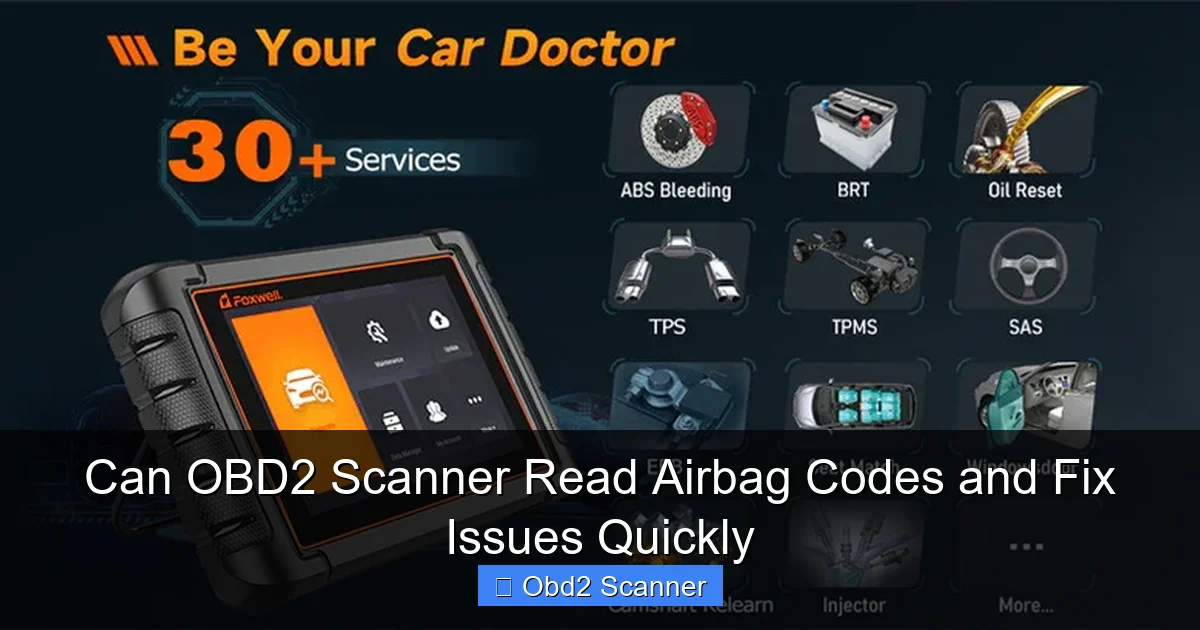
Visual guide about Can OBD2 Scanner Read Airbag Codes and Fix Issues Quickly
Image source: foxwelldiag.com
What an SRS code can indicate
- Faulty airbag module
- Seat belt pretensioner failure
- Clock spring or steering wheel connector issue
- Crash sensor damage
- Wiring or connector faults
- Low battery or bad battery connections
Step 2: Know if an OBD2 scanner can read airbag codes
Short answer: can OBD2 scanner read airbag codes? Yes, some can. Basic code readers only show engine-related codes. You need a scanner that supports SRS or airbag systems. Many mid-range and advanced OBD2 tools include SRS. Some Bluetooth adapters and phone apps also read airbag codes when paired with the right app.
Visual guide about Can OBD2 Scanner Read Airbag Codes and Fix Issues Quickly
Image source: cdn.shopify.com
Types of scanners and SRS support
- Basic OBD2 code readers — Usually no SRS support.
- Enhanced OBD2 scanners — Often include SRS functions.
- Professional scan tools — Full SRS diagnostics, live data, module coding.
- Bluetooth OBD2 adapters + apps — Varies by app and adapter capabilities.
Step 3: Choose the right OBD2 scanner
Picking the right tool is key. Ask if the tool supports SRS. Look for “SRS,” “Airbag,” or “Supplemental Restraint System” in specs. Read user reviews. Check compatibility with your car make and model. A scanner that lists full system coverage is best.
Visual guide about Can OBD2 Scanner Read Airbag Codes and Fix Issues Quickly
Image source: cdn.shopify.com
Practical tips for choosing a scanner
- Pick a scanner with SRS read and clear functions.
- Choose one with live data if possible.
- Prefer a brand with updates for newer cars.
- If you drive multiple brands, get wide vehicle coverage.
- For DIYers, a mid-range scanner is often enough.
Step 4: Prepare the vehicle and scanner
Get ready before you start. Park on a flat spot. Turn off the ignition. Set the parking brake. Read your owner’s manual for safety tips about the SRS. Have your scanner and any apps ready. If your scanner uses a phone, make sure Bluetooth is on and the app is installed.
Safety first
- Disconnect the negative battery terminal if you will touch SRS parts. Wait at least 10 minutes. Some vehicles require 90 seconds to 10 minutes.
- Do not tamper with an airbag that looks damaged.
- Wear safety glasses when working near the steering wheel or seats.
- If unsure, stop and call a professional.
Step 5: Connect the OBD2 scanner and read airbag codes
Now the hands-on steps. Follow them slowly. Keep sentences short. Use the scanner manual for button names. The steps below show a typical process.
Sub-step 5.1: Locate the OBD2 port
The OBD2 port is often under the dash. It may be near the steering column. Some cars have it behind a small cover. Plug your scanner into the port.
Sub-step 5.2: Power the scanner
Turn the ignition to the ON position. Do not start the engine unless the scanner needs that. Many scanners power from the vehicle after you turn the key to ON.
Sub-step 5.3: Select SRS or Airbag system
On the scanner menu, choose vehicle make if needed. Then select the SRS or Airbag system. Let the scanner connect. Wait for it to read the module.
Sub-step 5.4: Read and record the codes
The scanner will show trouble codes. Write them down. Take screenshots if your scanner or app allows it. Codes usually start with B (body) or U (network). Examples: B1234, U0123. The code list will help you research the fault.
Remember: can OBD2 scanner read airbag codes? If your tool shows SRS codes, it can. If not, you may need a different scanner.
Step 6: Interpret the airbag codes
Reading a code is just the start. The code needs a meaning. Use the scanner code description first. Then check a repair manual or a trusted online database. Codes often point to a circuit or sensor. They rarely say the exact failed part.
Examples of common SRS codes
- Clock spring failure — Often steering wheel airbag or horn issues.
- Passenger occupancy sensor fault — May affect passenger airbag deployment.
- Seat belt pretensioner fault — Indicates pretensioner circuit problem.
- Crash sensor or impact sensor short — May need sensor replacement.
- CAN bus communication errors — Network issues that affect modules.
Practical tip
Search online for the exact code plus your car make and model. That helps a lot. Forums and repair guides often list common failures for specific codes. Use that info to plan your next step.
Step 7: Perform basic checks before replacing parts
Many SRS faults come from simple issues. A visual check can fix many problems. Save time and money by checking first.
Checklist of basic checks
- Inspect airbag connectors under seats and dash.
- Check wiring for chafing or corrosion.
- Make sure battery terminals are clean and tight.
- Look for damaged sensors after an accident.
- Check seat position sensors and occupancy mat connections.
Example
Your code points to a passenger seat sensor. The seat connector might be loose. Wiggle the plug and reseat it. Re-scan. If the code clears, the fix is done.
Step 8: Clear airbag codes properly
After you fix the problem, you can clear the codes. Use your scanner’s clear or erase function. Follow the prompts. If the issue is fixed, the airbag light should stay off. If it returns, the root cause remains.
Important caution
Do not clear codes just to turn off the light. Clearing hides the problem. An unresolved airbag issue risks safety. Fix first, then clear.
Step 9: When your OBD2 scanner cannot clear SRS codes
Some scanners can read SRS codes but cannot clear them. Others may read only limited SRS data. If your scanner cannot clear the code, try a different tool. A professional scan tool or dealer tool usually can clear stubborn SRS codes. Also, some codes clear only after the vehicle runs self-tests or after a drive cycle.
What to do next
- Use a higher-level scan tool.
- Visit a repair shop with advanced diagnostic tools.
- Check for pending codes that may need time to clear.
Troubleshooting: Common problems and fixes
This section answers common issues you may face. Keep sentences short. Follow a clear path.
Issue 1: Scanner shows no SRS option
Solution: Ensure your scanner supports SRS. Update scanner firmware. Try a different make. Use a Bluetooth adapter with a compatible app that supports SRS for your car.
Issue 2: Airbag light stays on after clearing codes
Solution: Re-scan for new codes. Check wiring and connectors again. Some issues need module replacement. A trained technician may be required.
Issue 3: Airbag light flashes or behaves oddly
Solution: This often indicates a communication fault. Check the CAN bus and related fuses. A module may be failing. Get a professional diagnosis if needed.
Issue 4: Codes return after clearing
Solution: The underlying fault is still present. Follow code leads. Replace any damaged parts. After repairs, clear and test the system.
Issue 5: No power to OBD2 port
Solution: Check fuses. Some cars have a fused power supply for the OBD2 port. Replace blown fuses. Try another vehicle to test the scanner.
Practical safety advice when working on airbag systems
Airbags can be dangerous if mishandled. Use care. Follow these tips every time.
- Disconnect the battery before working on SRS components. Wait the recommended time.
- Do not place a metal tool near an airbag module while connected.
- Do not unbolt or tamper with an inflated or damaged airbag module.
- Replace airbag components with OEM or approved parts.
- Return the car to a dealer or specialist if you’re unsure.
When to call a professional
Some tasks need a trained hand. Call a pro in these cases:
- After a crash with airbag deployment.
- If you must replace the airbag control module.
- If the system shows intermittent or complex faults.
- When SRS codes read as module communication errors.
- If you lack the right tools or experience.
Real-world example: Fixing a stubborn airbag light
Case: A 2010 sedan had the airbag light on. The owner used a basic OBD2 reader. The reader showed engine codes but not SRS. The owner then used a mid-range scanner with SRS. The scanner read a code for the passenger occupancy sensor. A quick seat connector reseat fixed the problem. After clearing codes, the light stayed off.
Lesson: can OBD2 scanner read airbag codes? Yes, but choose the right tool. Many airbag issues are simple fixes.
Keeping a log and next steps
Write down the codes you find. Note the date and tests done. This helps later. If you must visit a mechanic, bring your logs. It saves time and money.
Conclusion
You now know: can OBD2 scanner read airbag codes? Many can. But not every OBD2 tool reads SRS codes. Use a scanner with SRS support to read and clear codes. Always fix the root cause before clearing codes. Follow safety steps. When in doubt, get a professional. With the right tool and care, you can diagnose and sometimes fix airbag issues quickly and safely.
🎥 Related Video: Topdon Elite OBD2 Scanner Review | Reads ABS and SRS Codes!
📺 2CarPros
Link to Product: http://amzn.to/2GHhhJf Here is a review for a pretty great scanner. This scanner can read codes like a normal …
