

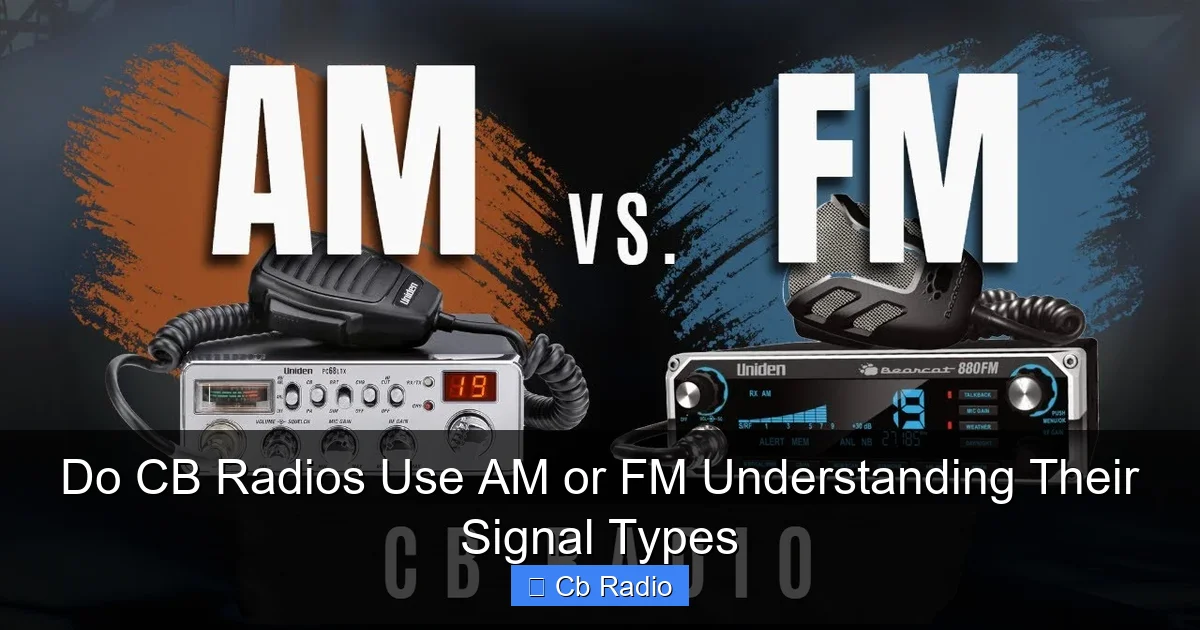
CB radios primarily use AM (Amplitude Modulation) for communication, but FM (Frequency Modulation) is also available on some channels and models. Understanding the differences between AM and FM on CB radios helps users choose the best mode for clear and reliable communication. This article explores how CB radios operate, their signal types, and practical tips for getting the most from your CB radio.
Contents
- 1 Key Takeaways
- 2 Quick Answers to Common Questions
- 3 📑 Table of Contents
- 4 Introduction
- 5 What Are AM and FM? Understanding the Basics
- 6 Do CB Radios Use AM or FM? The Traditional Standard
- 7 The Role of FM in CB Radio Communication
- 8 Practical Tips for Using AM and FM on Your CB Radio
- 9 Legal and Regulatory Considerations
- 10 Conclusion
- 11 Frequently Asked Questions
- 12 Author
Key Takeaways
- CB radios mainly use AM: Amplitude Modulation is the traditional and most common mode for CB communication.
- FM is available on some CB channels: Certain channels or models support FM for improved sound quality and reduced noise.
- AM and FM differ in signal behavior: AM is more susceptible to static, while FM offers clearer audio in noisy environments.
- Legal regulations influence mode use: Most countries regulate CB radios to use AM or FM on specific channels.
- Choosing between AM and FM depends on needs: For long-distance or noisy conditions, FM may be better, while AM works well for basic communication.
- Proper antenna setup enhances signal quality: Regardless of mode, antenna tuning and placement are crucial.
- Understanding modulation helps troubleshoot: Knowing whether your CB uses AM or FM can aid in fixing reception or transmission issues.
Quick Answers to Common Questions
Do all CB radios support both AM and FM?
No, most CB radios use AM only. Some models offer both AM and FM modes, but FM is usually limited to specific channels.
Which mode provides better sound quality on CB radios?
FM generally offers better sound quality with less static and noise compared to AM.
Can AM and FM CB radios communicate with each other?
No, AM and FM are different modulation methods, so radios must use the same mode to communicate.
Is FM legal on all CB channels?
No, FM is typically allowed only on certain channels like channel 38, depending on local regulations.
Does the antenna affect AM and FM signal quality on CB radios?
Yes, a properly tuned and placed antenna is important for good signal quality in both AM and FM modes.
📑 Table of Contents
Introduction
If you’ve ever wondered whether CB radios use AM or FM, you’re not alone. Citizens Band (CB) radios have been a popular communication tool for decades, especially among truckers, hobbyists, and emergency responders. But the question of their signal type—AM or FM—is key to understanding how these radios work and how to get the best performance from them.
In this article, we’ll dive into the world of CB radio signal types, exploring the differences between AM and FM modulation. You’ll learn why most CB radios use AM, when FM is an option, and how each affects your communication experience. Whether you’re a seasoned CB user or just starting out, this guide will clarify the technical side in simple terms and help you make informed decisions.
What Are AM and FM? Understanding the Basics
What is Amplitude Modulation (AM)?
Amplitude Modulation, or AM, changes the strength (amplitude) of the radio signal to carry information. Think of it as turning the volume of a wave up and down to encode your voice. AM has been used in radio communication for over a century and is known for its simplicity and wide coverage range.
Visual guide about Do CB Radios Use AM or FM Understanding Their Signal Types
Image source: i.ytimg.com
What is Frequency Modulation (FM)?
Frequency Modulation, or FM, varies the frequency of the carrier wave to transmit sound. Instead of changing the wave’s height, FM shifts how fast the wave cycles happen. This method is less prone to interference and static, which generally means clearer sound quality.
Key Differences Between AM and FM
- Sound Quality: FM usually offers better clarity and less static.
- Range: AM often covers longer distances, especially over open or rural areas.
- Susceptibility to Noise: AM is more affected by electrical interference.
- Complexity: FM transmitters and receivers tend to be more complex and costly.
Do CB Radios Use AM or FM? The Traditional Standard
CB Radios Mainly Use AM
Traditionally, CB radios operate using AM. In the United States and many other countries, the Federal Communications Commission (FCC) regulates CB radio use and designates AM as the primary mode for CB channels. This means most CB radios you buy will transmit and receive using AM signals.
AM’s long history with CB radios comes down to simplicity and compliance. AM equipment is less expensive and easier to manufacture. It also works well over the typical CB radio range of a few miles to tens of miles under the right conditions.
Why AM is Still Popular for CB
- Wide coverage area: AM signals can travel further, especially in flat or open terrain.
- Compatibility: Since most CB radios use AM, users can communicate with others regardless of brand or model.
- Legal standards: Many countries mandate AM as the standard for CB communications.
The Role of FM in CB Radio Communication
FM on CB Radios: Where It Fits In
While AM is the norm, some CB radios support FM on certain channels or as a selectable mode. FM CB radios have grown in popularity because of their clearer audio and reduced interference, especially in urban or noisy environments.
For example, in the United States, CB channel 38 is often used for FM mode under FCC regulations. This channel allows users to take advantage of FM’s benefits without interfering with the AM channels.
Advantages of FM on CB Radios
- Improved Audio Quality: FM provides crisper, clearer voice transmission with less static.
- Better Noise Immunity: FM signals resist electrical noise from engines, power lines, and other sources.
- Less Fading: FM signals generally maintain consistent strength, reducing the fading effect common with AM.
Limitations of FM on CB
Despite its advantages, FM on CB radios is not without drawbacks:
- Shorter Range: FM signals usually don’t travel as far as AM signals.
- Limited Channels: FM is often restricted to a few channels or specific models.
- Compatibility Issues: Users must ensure both radios support FM to communicate effectively.
Practical Tips for Using AM and FM on Your CB Radio
Choosing the Right Mode for Your Situation
Deciding between AM and FM depends on your environment and communication needs. If you are in a rural area with few interference sources, AM is often sufficient and may provide longer range. In urban settings with lots of electrical noise, FM can offer clearer conversations.
How to Switch Between AM and FM on Your Radio
Many modern CB radios have a mode switch or menu option to toggle between AM and FM. Check your user manual for instructions. Always confirm that the channel you select supports the mode you want to use.
Optimizing Antennas for Both Modes
Your antenna plays a big role in signal quality. For both AM and FM, a properly tuned antenna matched to the CB frequency band (around 27 MHz) is crucial. A well-placed antenna, free from obstructions, will improve both transmission and reception.
Using Filters and Noise Reducers
To reduce static and interference on AM, consider using noise filters or noise blankers built into some CB radios. For FM, proper squelch settings help eliminate background noise when no signal is present.
Legal and Regulatory Considerations
FCC and International Rules
In the U.S., the FCC regulates CB radio use, including permitted frequencies, power limits, and modulation types. AM is generally required on most channels, but FM is legal on specific channels like channel 38. Other countries have similar rules, so it’s important to check local regulations before using FM on CB.
Power Limits and Interference
CB radios typically have a power limit of 4 watts for AM and 12 watts for FM. Exceeding these limits can cause interference and legal issues. Staying within prescribed limits ensures clear communication and compliance.
Conclusion
So, do CB radios use AM or FM? The answer is that most CB radios primarily use AM, but FM is available on some channels and models. AM remains the standard due to its simplicity, range, and regulatory status. However, FM offers clear advantages in sound quality and noise resistance, making it a valuable option depending on your needs.
Understanding the differences between AM and FM on CB radios helps you choose the right mode for your communication style and environment. Whether you’re a trucker on the highway or a hobbyist chatting with friends, knowing your radio’s signal type enhances your experience and reliability.
Remember, proper antenna setup, adherence to regulations, and choosing the right mode for your location will maximize your CB radio’s performance. Now you’re ready to get on the air with confidence, knowing exactly how your CB radio sends and receives signals!
Frequently Asked Questions
Why do most CB radios use AM instead of FM?
AM is simpler, cheaper to produce, and has been the standard modulation for CB radios since their inception. It also offers longer range in ideal conditions, making it suitable for CB communication.
Can I switch my CB radio from AM to FM anytime?
If your CB radio supports both modes, you can switch between AM and FM depending on the channel and your needs. However, not all radios have this option, so check your model’s capabilities.
Does FM use more power than AM on CB radios?
FM CB transmissions often use higher power limits (up to 12 watts) compared to AM (usually 4 watts), but this varies by regulation and radio model.
Are there specific channels reserved for FM on CB radios?
Yes, for example, in the U.S., channel 38 is designated for FM to reduce interference and improve communication quality.
How does interference affect AM and FM on CB radios?
AM is more prone to static and electrical noise, which can degrade audio quality. FM is better at resisting interference, resulting in clearer sound.
What should I consider when buying a CB radio regarding AM and FM?
Consider whether you want the flexibility of both AM and FM modes, check channel support, and ensure compliance with local regulations. Also, look at antenna options and power output to suit your communication needs.