

Do OBD2 scanners work on diesel vehicles? Yes, many do. This guide shows how to pick the right scanner, connect it, read diesel codes, and use live data. Follow the steps to diagnose common diesel issues with ease.
Contents
- 1 Key Takeaways
- 2 Introduction
- 3 Step 1: Understand OBD2 and Diesel Basics
- 4 Step 2: Check Vehicle Year and Region
- 5 Step 3: Diesel-Specific Protocols and PIDs
- 6 Step 4: Choose the Right Scanner
- 7 Step 5: How to Connect an OBD2 Scanner to a Diesel Vehicle
- 8 Step 6: Reading and Interpreting Diesel Codes
- 9 Step 7: Using Live Data and Logging
- 10 Step 8: Diesel Service Functions and Limitations
- 11 Step 9: Real-World Examples and Tips
- 12 Troubleshooting
- 13 Maintenance and Best Practices
- 14 When to See a Professional
- 15 Conclusion
- 16 Author
Key Takeaways
- Point 1: Most modern OBD2 scanners work on diesel vehicles built after 1996 (US) and 2001 (EU), but check vehicle year and protocol first.
- Point 2: Diesel engines use some unique codes and PIDs, like DPF, SCR, and glow plug data, which not all scanners read.
- Point 3: Choose a scanner with diesel-specific functions if you need DPF regeneration, injector coding, or advanced live data.
- Point 4: Use a quality OBD2 tool and the right app or software for best results on diesel vehicles.
- Point 5: Step-by-step connection, safe testing, and clear interpretation reduce errors when diagnosing diesel problems.
- Point 6: If a scanner can’t clear a diesel code or perform a service function, consult a diesel specialist or dealer.
Introduction
This guide answers the simple question: do obd2 scanners work on diesel vehicles? You will learn which scanners work, what limits exist, and how to use a scanner on a diesel truck or car. You will also get step-by-step instructions for connecting, reading codes, using live data, and doing common diesel tasks. The tone is simple. The steps are practical. You will learn what to try yourself and when to call a pro.
Step 1: Understand OBD2 and Diesel Basics
OBD2 is a standard port and data set used for diagnostics. It started in the mid-1990s. It covers engines, emissions, and other systems. But diesel engines can be different. So ask: do obd2 scanners work on diesel for your car? The answer depends on the vehicle year, region, and the scanner’s features.
Visual guide about Do OBD2 Scanners Work on Diesel Vehicles Quick Tips
Image source: scanneranswers.com
What OBD2 covers
- Emission-related fault codes (P0xxx).
- Freeze frame data and emission monitors.
- Live sensor data via PIDs (Parameter IDs).
Why diesel differs
- Diesel engines use different sensors and subsystems. Examples: DPF, EGR, SCR, glow plugs.
- Some diesel codes are manufacturer-specific.
- Certain diesel service functions need advanced tools.
Step 2: Check Vehicle Year and Region
Start by confirming your vehicle year and where it was sold. This helps answer do obd2 scanners work on diesel in your case.
Visual guide about Do OBD2 Scanners Work on Diesel Vehicles Quick Tips
Image source: youcanic.com
United States
All cars and light trucks sold from 1996 onward must have an OBD2 port. This includes most diesel passenger vehicles. Heavy-duty diesel trucks may use a different standard (J1939/J1708).
Europe
Diesel cars roughly followed similar rules from 2001 (Euro 3/4 era) and later. Many European diesels use OBD2 or EOBD. Heavy-duty diesels often use J1939.
Other regions
Rules vary. Check your local laws and your vehicle manual. For older diesel vehicles, OBD1 or proprietary systems may be used. In those cases, standard OBD2 scanners may not work.
Step 3: Diesel-Specific Protocols and PIDs
To answer do obd2 scanners work on diesel you must know protocol support. Scanners communicate in different protocols. Diesel vehicles may use:
Visual guide about Do OBD2 Scanners Work on Diesel Vehicles Quick Tips
Image source: m.media-amazon.com
- ISO 9141-2
- ISO 14230 (KWP2000)
- ISO 15765 (CAN)
- SAE J1939 (heavy-duty diesels)
What are PIDs?
PIDs are the data points a scanner can read. Standard PIDs cover engine speed, coolant temperature, and more. Diesel vehicles may have extra PIDs for:
- DPF soot load
- NOx levels
- SCR dosing unit data
- Injector balance and timing
- Glow plug status
Not all scanners read manufacturer or diesel-specific PIDs. If you need those values, check scanner specs.
Step 4: Choose the Right Scanner
Your answer to do obd2 scanners work on diesel is only as good as your tool. Choose a scanner that matches the vehicle and your goals.
Basic code readers
- Read/clear basic codes and MIL (check engine light).
- Good for DIYers with simple needs.
- May not show diesel-specific PIDs or service functions.
Advanced OBD2 scanners
- Support many protocols including CAN and some J1939.
- Show live data, freeze frame, readiness monitors.
- Often read more diesel PIDs.
Professional diesel scanners
- Can do DPF regen, injector coding, and module programming.
- Support heavy-duty protocols (J1939/J1708).
- Best for fleet trucks and advanced repairs.
Bluetooth adapters and apps
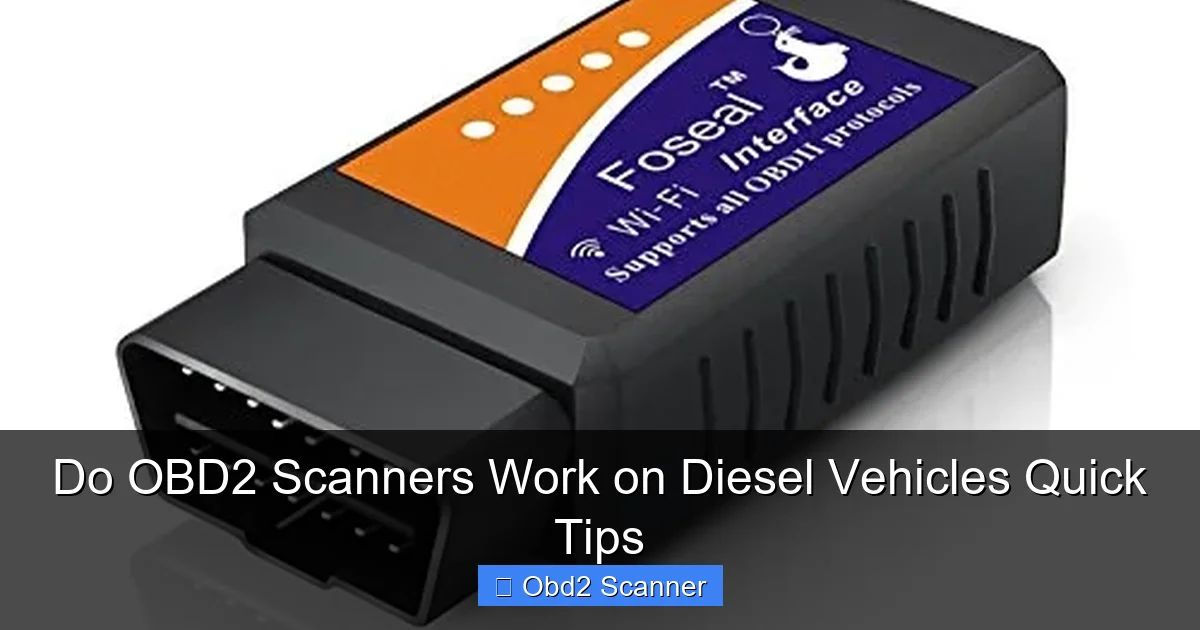
Bluetooth OBD2 adapters are cheap and handy. Pair with a phone app for graphs and logging. But confirm the app supports diesel PIDs. Many free apps focus on gasoline engines. If you ask do obd2 scanners work on diesel via a cheap adapter, check compatibility first.
Step 5: How to Connect an OBD2 Scanner to a Diesel Vehicle
This section walks you through connecting a scanner. Follow safe steps to answer do obd2 scanners work on diesel in practice.
Step A: Locate the OBD2 port
- Look under the dash on the driver side.
- On trucks, the port may be under a panel or in the center console.
- Heavy-duty trucks may have multiple connectors or use a different port.
Step B: Turn off ignition
Turn ignition off before plugging in. This protects the scanner and car electronics.
Step C: Plug in the scanner
Insert the connector firmly. For Bluetooth adapters, plug in and pair the device with your phone or tablet.
Step D: Turn ignition on
Switch to the ON position. Do not start the engine unless the procedure asks you to.
Step E: Select vehicle or protocol
Some scanners auto-detect. Others ask you to choose the make, model, and year. If your scanner has a manual protocol selection, pick one that matches your diesel (CAN or J1939 if specified).
Step 6: Reading and Interpreting Diesel Codes
Once connected, you will see codes, live data, and status info. This step explains what the codes mean on a diesel.
Generic vs manufacturer codes
- Generic codes (P0xxx) are standard and readable by most scanners.
- Manufacturer codes (P1xxx) are specific to a brand. Some readers need paid upgrades to decode them.
Common diesel-specific codes and systems
- DPF codes: Often relate to soot load, differential pressure sensor faults, or regeneration failures.
- SCR/NOx codes: Refer to urea dosing system faults and NOx sensor errors.
- Glow plug/starting codes: These show heater circuit issues or controller faults.
- Fuel injection/injector codes: Can indicate timing or balance issues.
Interpreting code severity
Not all codes mean immediate breakdown. Some are warning-level. Others require urgent action. Use live data to check the context. For example, a DPF soot load code with high soot% and low regen attempts needs attention soon. A single misfire code at idle may be minor if it clears.
Step 7: Using Live Data and Logging
Live data helps confirm problems. Most advanced scanners show graphs. Use them to watch sensors while you rev the engine. This answers deeper questions about do obd2 scanners work on diesel beyond code reads.
Key diesel live data points
- Engine RPM
- Boost pressure (turbo)
- Fuel rail pressure
- Exhaust temp (for DPF)
- DPF soot load %
- NOx levels and urea dosing rate
- Glow plug voltage
How to log and compare
Record data during normal driving and under load. Compare to known good values or factory specs. Use graphs to spot trends like rising exhaust temps or failing boost at higher RPM.
Step 8: Diesel Service Functions and Limitations
Some tasks need more than just reading codes. Many users ask, do obd2 scanners work on diesel for tasks like DPF regen or injector coding? The answer: sometimes, but check tool features.
DPF regeneration
Basic scanners can tell you soot load. Some advanced scanners can command a forced regen. Follow safety steps. Forced regen raises exhaust temps and should be done in a safe area with the vehicle running steadily.
Injector coding and adaptation
These functions are advanced. Many aftermarket OBD2 tools cannot perform them. Professional tools or dealer tools are often required.
Module programming
Programming or replacing engine modules usually needs dealer-level access. Aftermarket scanners may not unlock these features. Know your tool limits.
Step 9: Real-World Examples and Tips
Here are quick examples that show how do obd2 scanners work on diesel in real life.
Example 1: DPF warning on a VW TDI
- Scanner shows P2002 and high soot load.
- Live data shows low exhaust temp and few regen attempts.
- Solution: Drive at highway speed to allow passive regen. If that fails, use a tool that can run a forced regen.
Example 2: NOx sensor fault on a Ford Power Stroke
- Scanner shows manufacturer code for NOx sensor.
- Live data shows erratic NOx readings during drive.
- Solution: Confirm wiring and sensor readings. Replace sensor if needed or use dealer tool for system relearn.
Practical tips
- Always update the scanner firmware and app.
- Use the correct vehicle selection in the scanner menus.
- Take photos of codes and live data for forum help or a mechanic.
- Start with free info online, but verify with service manuals.
Troubleshooting
When a scanner does not work, follow this checklist. It helps whether you wonder do obd2 scanners work on diesel or face a connection issue.
Scanner does not connect
- Check that the ignition is ON.
- Try another cable or adapter.
- Confirm port power (12V at pin 16 on most OBD2 ports).
- For heavy-duty trucks, check J1939 port location; standard OBD2 may not apply.
Codes unreadable or gibberish
- Update scanner software.
- Select the correct vehicle make and year.
- Some manufacturer codes need a subscription or paid software module.
Live data missing diesel PIDs
- Your scanner may not support manufacturer or diesel PIDs.
- Try a diesel-focused app or pro tool.
Forced regen fails
- Ensure engine is at operating temperature.
- Check for blocked DPF or faulty differential pressure sensor.
- Use a high-quality scanner that supports forced regen and follow safety steps.
Maintenance and Best Practices
To get the best answers to do obd2 scanners work on diesel, keep tools and habits sharp.
- Keep scanner firmware and app up to date.
- Store adapters protected from dirt and moisture.
- Use a quality battery or maintain vehicle battery voltage during tests.
- Record test data. It helps diagnose intermittent faults.
- Read the vehicle manual for any special procedures before clearing codes or forcing service functions.
When to See a Professional
Some diesel repairs are complex. If you can’t clear a code, if forced regen fails, or if injector coding is needed, see a diesel technician. For safety and emissions compliance, a pro can do module programming and deep diagnostics.
Conclusion
So, do obd2 scanners work on diesel vehicles? Yes. Most modern scanners will read basic codes and live data on diesel cars. Heavy-duty trucks may need J1939 support. Diesel systems also include unique PIDs and service functions. If you need DPF regen, injector coding, or module programming, choose a scanner with those diesel-specific features or visit a pro. Start with the right tool and follow the steps here. You will diagnose with more confidence.
🎥 Related Video: Using Car Scanner Pro to confirm current Protocol
📺 Thomas J Baker
Car Scanner Pro has a terminal screen listed in “Settings”. From there you can send custom commands as well as interact with the …
