

Does OBD2 scanner clear codes? Yes, many scanners can erase stored codes, but clearing is not always the right step. This guide shows you how to clear codes with an OBD2 scanner, when to do it, and how to verify repairs before you erase data.
Contents
- 1 Key Takeaways
- 2 Introduction: What you will learn
- 3 Quick answer: does obd2 scanner clear codes?
- 4 Step 1: Choose the right OBD2 scanner
- 5 Step 2: Prepare your vehicle and scanner
- 6 Step 3: Read codes and record data
- 7 Step 4: Diagnose and fix the root cause
- 8 Step 5: Clear codes with your OBD2 scanner
- 9 Step 6: Verify repairs and re-scan
- 10 When you should not clear codes
- 11 Practical tips and examples
- 12 Troubleshooting: common problems and fixes
- 13 Legal and ethical considerations
- 14 Advanced topics: permanent codes and module resets
- 15 Choosing between basic and advanced scanners
- 16 Cost and value
- 17 Summary checklist before clearing codes
- 18 Conclusion
- 19 Author
Key Takeaways
- Point 1: Many OBD2 scanners can clear codes, but the function varies by model and app.
- Point 2: Clearing codes does not fix the root cause. It only erases stored fault data and turns off the light temporarily.
- Point 3: Always read and record codes first. Note freeze frame data and repair steps before you clear.
- Point 4: After you clear codes, drive a few cycles and re-scan to ensure the issue is fixed.
- Point 5: Use a quality scanner and follow safety steps. Some advanced systems need manufacturer tools to clear persistent codes.
- Point 6: Clearing codes before inspection may mask issues and is often illegal in some regions.
Introduction: What you will learn
This guide answers the common question: does obd2 scanner clear codes? You will learn how to use a scanner to read and clear codes. You will learn when you should clear codes and when you should not. You will get step-by-step instructions. You will get tips, examples, and troubleshooting steps. The guide uses plain language. It is friendly and simple.
Quick answer: does obd2 scanner clear codes?
Yes. Most OBD2 scanners can clear codes. Many handheld scanners and Bluetooth OBD2 adapters have a clear or erase function. But not all scanners do this. Some basic readers only show codes. Also, some faults are stored in modules that need special tools to reset. So the short answer to “does obd2 scanner clear codes” is yes in most cases, but with important limits.
Visual guide about Does OBD2 Scanner Clear Codes and When You Should Know
Image source: axlewise.com
Step 1: Choose the right OBD2 scanner
Not all scanners are the same. You must pick the right tool for your car and your goals. Here is how to choose.
Visual guide about Does OBD2 Scanner Clear Codes and When You Should Know
Image source: obdcore.com
Pick by function
Some scanners only read codes. Some can read/live data and clear codes. Some can run advanced tests. If you ask “does obd2 scanner clear codes”, check the product specs for “erase” or “clear DTCs”.
Pick by vehicle
Most modern cars use OBD2. Older cars may not. Some brands need dealer tools for full control. If your car is a luxury or diesel model, check compatibility.
Pick by budget
Low-cost readers work for basic needs. Mid-range units add live data and freeze-frame info. High-end units add bi-directional controls and service resets. Decide how deep you want to go.
Step 2: Prepare your vehicle and scanner
Preparation keeps things simple and safe. Follow these steps every time.
Visual guide about Does OBD2 Scanner Clear Codes and When You Should Know
Image source: obdcore.com
Safety and location
Park on level ground. Turn off the engine. Apply the parking brake. Put the car in park or neutral as needed. Work in a ventilated area if you will run the engine during tests.
Find the OBD2 port
The port is usually under the dash on the driver side. It can be in the kick panel or center console. It is a 16-pin connector. Plug the scanner in firmly.
Power and ignition
Some scanners power from the car. Others have internal batteries. Turn the ignition to the ON position without starting the engine when the scanner asks. Some functions need the engine running.
Step 3: Read codes and record data
Never clear codes before reading them. You need information for proper repair. Follow these steps.
Scan for codes
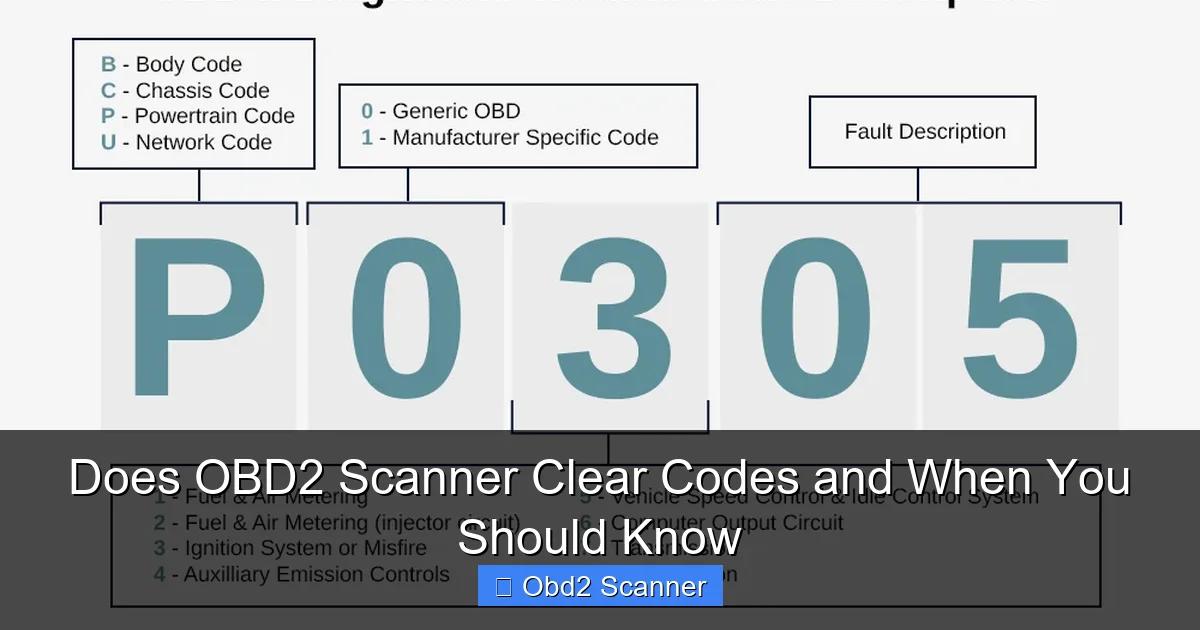
Use the scanner to read stored, pending, and permanent codes. Many units label them P0xxx, Bxxxx, Cxxxx, or Uxxxx. Note all codes. This answers “does obd2 scanner clear codes”, because you need to see what will be erased.
Record freeze frame and live data
Freeze frame shows conditions when the fault happened. Save this data. Many scanners allow saving or printing. If not, write it down. Live data helps diagnose intermittent issues.
Note the part and repair advice
Some scanners give code descriptions. Use that as a starting point. But do not assume a part is bad just because of a code. Use the code to guide testing.
Step 4: Diagnose and fix the root cause
Clearing codes is only useful if the problem is fixed first. Follow a logical diagnosis plan.
Use the code as a starting point
Check wiring, connectors, and sensors related to the code. Test sensors with a multimeter if needed. Use live data to confirm odd readings. Replace or repair faulty parts.
Example: P0301 misfire
If you see a P0301 (cylinder 1 misfire), check spark plug, coil, injector, and compression. Fix the root cause. Do not only clear the code. Clearing without repair will let the light return.
Step 5: Clear codes with your OBD2 scanner
Now you can clear codes. This answers the question “does obd2 scanner clear codes” in practical steps. Follow this safe method.
Back up your data
Ensure you saved codes and freeze frame data. Once cleared, this data can be lost. Many scanners store a history. But some do not.
Find the erase function
On your scanner, select “Erase Codes”, “Clear DTCs”, or similar. The menu name varies. Confirm the action when prompted.
Clear codes
The scanner will send a command to the car and delete stored codes. The check engine light will usually go off. Some cars require a drive cycle. Permanent codes may not erase until conditions pass.
Step 6: Verify repairs and re-scan
Clearing codes is not the end. You must confirm the issue is fixed.
Drive cycles
Drive the car for several short trips or one longer trip. Normal driving lets the car run its self-tests. If the problem is fixed, codes should not return.
Re-scan the vehicle
Plug the scanner back in and read codes again. If no codes appear, you fixed it. If codes return, the fault persists. Re-check the diagnosis.
When you should not clear codes
Knowing when not to clear codes is as important as knowing how. Here are common situations to avoid clearing codes.
Before inspection
Clearing codes just to pass inspection is risky and sometimes illegal. Inspections may check readiness monitors that reset after a clear. A cleared car may fail inspection because monitors are incomplete.
Before diagnosing
Do not clear codes before you record them. You will lose vital data. This makes diagnosis harder and may increase repair costs.
When modules need special tools
Some modules store permanent or pending codes that only dealer tools can clear. If you clear codes manually, they may reappear or leave the module in a fault state.
Practical tips and examples
These tips help you use a scanner like a pro.
- Tip 1: Always write down the code and description before clearing. This saves time later.
- Tip 2: If the light returns after clearing, scan immediately to capture freeze frame data.
- Tip 3: Use a smartphone app with a Bluetooth adapter for easy logging and screenshots.
- Tip 4: For intermittent faults, try a road test with live data recording.
- Tip 5: Keep a basic multimeter and vacuum gauge for simple tests.
Example: oxygen sensor code
An O2 sensor code often means the sensor is aging or fuel trim is off. Read codes, check fuel pressure, then replace the sensor if tests show it is bad. After the repair, use the scanner to clear codes and confirm the light stays off after a drive cycle.
Troubleshooting: common problems and fixes
Here are common problems when you try to clear codes and how to fix them.
Problem: Codes return after clearing
Fix: The issue was not fixed. Re-scan. Capture live data and freeze frame. Repair the root cause. Clear and re-test.
Problem: Check engine light stays on after clearing
Fix: Some cars require a cold start or a few drive cycles. If the light stays on, there may be a stored permanent code. Use a more advanced scanner or consult a pro.
Problem: Scanner cannot connect or fails to erase
Fix: Check the connector and ignition position. Try another scanner. Some vehicles disable OBD2 port until the engine runs. Update scanner firmware if available.
Problem: Monitors show “Not Ready” after clearing
Fix: This is normal. Readiness monitors reset after erasing. Drive the car through a full cycle. Follow the manufacturer’s drive cycle to set monitors ready again.
Problem: Permanent codes or ECU locks
Fix: Some control modules record permanent codes that only dealer tools can clear. Contact a dealer or qualified shop if a module must be reset.
Legal and ethical considerations
Clearing codes to hide real problems is unsafe. It may be illegal. Emissions laws vary by region. Do the right thing. Fix issues rather than hide them.
Advanced topics: permanent codes and module resets
Some trouble codes are stored as permanent entries. These are often called “permanent DTCs”. They remain after clearing. Permanent codes help ensure emissions systems are repaired. Only certain tools can remove them after the car proves the repair by completing tests. If you wonder “does obd2 scanner clear codes permanently”, the answer is sometimes no. Permanent codes may need special tools and successful drive cycles to clear.
Choosing between basic and advanced scanners
Basic scanners are fine for quick checks. But if you plan to do repairs, choose a unit with live data and freeze-frame capability. For complex systems, a mid-range or dealer-level tool may be needed. Ask if the scanner supports erase/clear DTCs, readiness monitors, and module-specific functions.
Cost and value
Basic code readers cost $20–$50. Mid-range units cost $100–$400. Professional tools are $500+. Think about how often you will use the tool. For one-time checks, a low-cost reader may be fine. For DIY repairs, spend more for live data and better diagnostics.
Summary checklist before clearing codes
- Read and record all codes.
- Save freeze frame and live data.
- Diagnose and fix the root cause.
- Back up scanner logs if possible.
- Clear codes and run drive cycles.
- Re-scan to verify success.
Conclusion
So, does obd2 scanner clear codes? Yes, many scanners can erase codes. But clearing alone does not fix issues. You must read codes first. Diagnose and repair the problem. Use the scanner to clear and then verify the repair with drive cycles and re-scans. Use a proper tool for your vehicle. Do not clear codes to hide problems. Follow safety and legal rules. That is the right way to use an OBD2 scanner.
🎥 Related Video: Affordable OBD 2 scanner #foxwell link in bio #fyp #mechanic #autodiagnostico #obdscanner
📺 MeDoMechanic
My daily use tools …
