

For the best CB radio signal reception, antenna height is crucial. Placing your CB antenna as high as possible, ideally above the roofline or on a tall mast, can significantly improve communication range and clarity. This guide explains the ideal antenna heights, installation tips, and how to optimize your setup for clear, strong CB signals.
Contents
- 1 Key Takeaways
- 2 Quick Answers to Common Questions
- 3 📑 Table of Contents
- 4 How High Should a CB Radio Antenna Be for Best Signal Reception
- 5 Why Does Antenna Height Matter for CB Radios?
- 6 Ideal Heights for Different CB Antenna Setups
- 7 Practical Tips to Maximize Antenna Height and Performance
- 8 How Height Affects Communication Range
- 9 Common Mistakes to Avoid When Installing CB Antennas
- 10 Conclusion: Getting the Most from Your CB Antenna Height
- 11 Frequently Asked Questions
- 12 Author
Key Takeaways
- Optimal Height Matters: Higher placement generally improves CB radio reception and transmission range.
- Above Roofline is Ideal: Mounting the antenna above the vehicle or building roofline reduces signal interference.
- Use Tall Masts or Poles: A taller mast can boost antenna height in stationary setups like base stations.
- Clear Line of Sight Helps: Avoid obstructions like trees or buildings near your antenna for better signals.
- Proper Grounding Enhances Performance: Good grounding reduces noise and signal loss.
- Consider Local Regulations: Check height restrictions or zoning laws before installing tall antennas.
- Fine-Tuning is Key: Adjust antenna length and position for best SWR and signal strength.
Quick Answers to Common Questions
How tall should a CB antenna be on a vehicle?
It should be mounted as high as possible, ideally on or above the roofline, to reduce obstructions and improve signal range.
Can I use a taller antenna for better reception?
Yes, taller antennas generally improve reception and range, especially for base stations where height can be increased easily.
Does antenna height affect CB radio range?
Absolutely. Higher antennas have better line-of-sight and can communicate over longer distances.
Is grounding important for CB antennas?
Yes, proper grounding reduces noise and improves signal clarity, especially for base stations.
What if I can’t mount my antenna very high?
In that case, consider adjusting antenna length, using loading coils, or relocating to a clearer spot to improve performance.
📑 Table of Contents
- How High Should a CB Radio Antenna Be for Best Signal Reception
- Why Does Antenna Height Matter for CB Radios?
- Ideal Heights for Different CB Antenna Setups
- Practical Tips to Maximize Antenna Height and Performance
- How Height Affects Communication Range
- Common Mistakes to Avoid When Installing CB Antennas
- Conclusion: Getting the Most from Your CB Antenna Height
How High Should a CB Radio Antenna Be for Best Signal Reception
If you’re serious about your CB radio setup, you’ve probably wondered, how high should a CB radio antenna be? Antenna height plays a huge role in how well your CB radio communicates. Whether you’re driving down the highway or operating from a base station, the antenna’s position can make or break your signal quality.
CB radios operate on the 27 MHz frequency band, which means their signals travel in a line-of-sight manner, and height can boost the range. The higher your antenna, the fewer obstacles the radio waves have to pass through. This article dives deep into the ideal heights for CB antennas, what factors affect signal strength, and practical tips for installation.
Why Does Antenna Height Matter for CB Radios?
The Basics of Radio Wave Propagation
CB radio signals travel primarily by direct waves—straight lines from the antenna to the receiver. The Earth’s surface can block or reflect these waves, so the higher your antenna, the better your chances of a clear path to other radios.
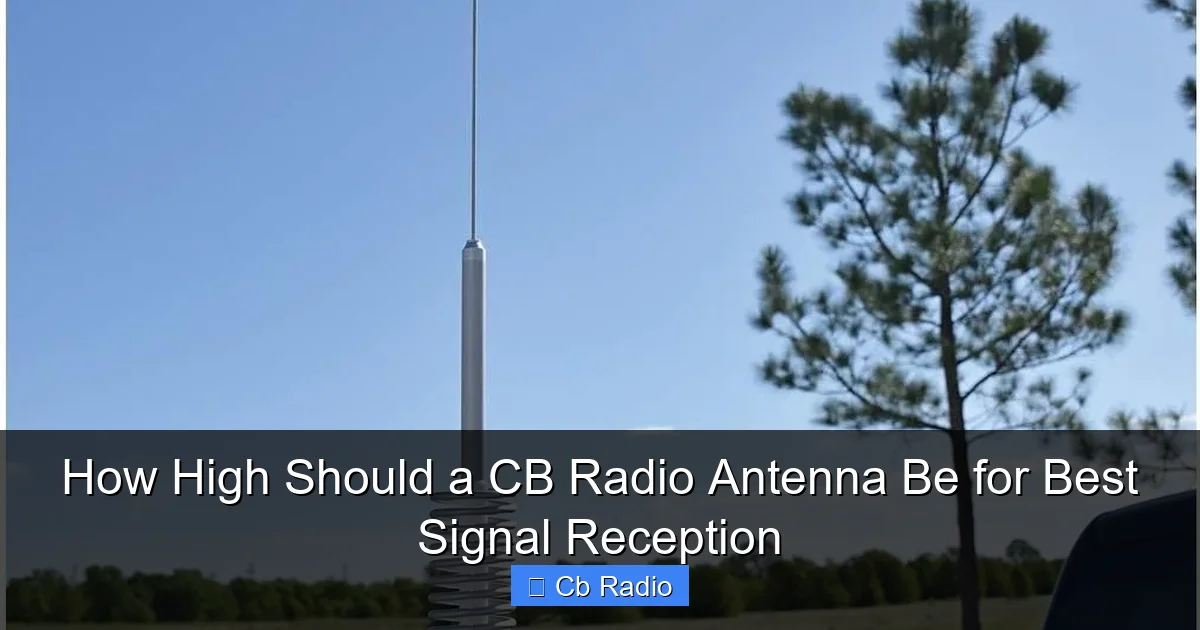
Visual guide about How High Should a CB Radio Antenna Be for Best Signal Reception
Image source: m.media-amazon.com
Reducing Obstructions and Interference
Objects like vehicles, trees, hills, and buildings can weaken or reflect your signal. By raising your antenna, you reduce the chance of these obstacles interfering with your transmission. This means clearer reception and longer communication distances.
Ideal Heights for Different CB Antenna Setups
Vehicle-Mounted Antennas
For mobile CB radios, the antenna is usually mounted on the vehicle. The general rule is to install the antenna as high as possible on your vehicle’s body, ideally above the roofline. This could mean mounting it on the roof, on a tall magnet mount, or a sturdy whip antenna fixed to the truck bed or bumper.
Example: A CB antenna mounted on the roof of a pickup truck will typically perform better than one attached low on the bumper because the roof antenna has fewer obstructions and better signal propagation.
Base Station Antennas
For home or base stations, antenna height is even more flexible. Ideally, mount the antenna on a mast or tower that raises it well above the roofline—often 20 feet or more. The higher you go, the better your coverage area.
Many CB enthusiasts use towers or long poles to get their antennas above nearby trees and buildings. Some even use rooftop mounts or chimney brackets to increase height without complicated installations.
Practical Tips to Maximize Antenna Height and Performance
Using Masts and Poles
If you’re installing a base station, investing in a telescoping mast or fiberglass pole can help you achieve the desired height. These are lightweight, weather-resistant, and easy to assemble. Make sure to securely mount the mast and ground it properly for safety.
Choosing the Right Antenna Length
The height of your antenna also relates to its length. A typical CB antenna is about 102 inches (8.5 feet) long, tuned to a quarter wavelength for 27 MHz. If you’re mounting lower than ideal, you may need to adjust antenna length or add loading coils to maintain good SWR (Standing Wave Ratio).
Clear the Surrounding Area
Try to keep the immediate area around your antenna free from metallic objects, wires, and other antennas. These can cause signal reflection and reduce effective height. Even nearby trees can absorb or scatter signals, so trim branches if possible.
Grounding for Better Reception
Grounding your CB antenna or base station is often overlooked but critical. A good ground reduces noise, improves signal clarity, and protects your equipment. For vehicle antennas, the metal body acts as a ground plane, but base stations require dedicated grounding rods or plates.
How Height Affects Communication Range
Typical Range Expectations
A well-placed CB antenna mounted high can reach 10-15 miles easily under normal conditions. In flat, open areas and with a very tall antenna, this range can extend up to 20 miles or more. Conversely, a low-mounted antenna may only reach a few miles due to obstructions and signal loss.
Examples of Height Impact
- Low Antenna (below roofline): Might struggle with nearby hills or buildings, limited to 2-5 miles.
- Roof-mounted Vehicle Antenna: Clearer signal, 10-15 miles range.
- Base Station Antenna on 20+ ft Mast: Potentially 15-25 miles or more in good conditions.
Common Mistakes to Avoid When Installing CB Antennas
Mounting Too Low
Placing your antenna too low, such as inside the vehicle or under the bumper, severely limits signal reach. It’s tempting for convenience, but avoid it if you want good communication.
Poor Grounding
Not grounding your antenna properly increases static and signal distortion. Always use proper grounding rods and check connections regularly.
Ignoring SWR Tuning
High SWR means power is reflected back to the radio, reducing efficiency. After installation, use an SWR meter to fine-tune antenna length and placement.
Conclusion: Getting the Most from Your CB Antenna Height
To sum up, the height of your CB radio antenna matters a lot for signal strength and range. The higher you place it—ideally above rooflines or on tall masts—the better your radio will perform. Keep it clear of obstructions, properly grounded, and tuned for best results.
Whether you’re on the road or at home, investing time in the right antenna height can turn a frustrating experience into smooth, reliable communication. Now that you know how high your CB radio antenna should be, it’s time to get out there and enjoy crystal-clear conversations!
Frequently Asked Questions
Why is antenna height important for CB radios?
Antenna height affects the line-of-sight for radio waves. The higher the antenna, the fewer obstacles in the way, resulting in better signal strength and range.
Can a low-mounted CB antenna still work well?
While it can work, a low-mounted antenna will have limited range and may experience more interference from nearby objects.
How do I know if my antenna is at the right height?
Check for clear line-of-sight around the antenna and measure your SWR. If your signal is weak or range is limited, increasing height usually helps.
Is there a maximum height for CB antennas?
There’s no strict maximum, but local regulations or physical constraints often limit how tall you can go. Always check local laws before installing tall antennas.
What is the ideal antenna length for CB radios?
The ideal length is about 102 inches (8.5 feet), which corresponds to a quarter wavelength for 27 MHz. Antenna length should be adjusted if mounted lower than standard heights.
Do trees and buildings affect CB antenna height effectiveness?
Yes, trees and buildings can block or absorb signals, so placing your antenna higher than these obstacles improves reception and transmission quality.