

CB radios operate on specific frequencies within the 27 MHz band, designated for citizen communication. Understanding these frequencies helps users communicate clearly and legally using CB radios. This guide breaks down the basics of CB radio frequencies, making it easy for beginners to grasp how these radios work and what frequency they use.
Contents
- 1 Key Takeaways
- 2 Quick Answers to Common Questions
- 3 📑 Table of Contents
- 4 What Frequency Does CB Radio Use Explained for Beginners
- 5 Understanding the CB Radio Frequency Range
- 6 Popular CB Radio Channels and Their Uses
- 7 Transmission Modes on CB Radio Frequencies
- 8 Practical Tips for Using CB Radio Frequencies Effectively
- 9 The Legal Side of CB Radio Frequencies
- 10 Conclusion
- 11 Frequently Asked Questions
- 12 Author
Key Takeaways
- CB radios use frequencies in the 27 MHz band: Specifically, 40 channels between 26.965 MHz and 27.405 MHz.
- Channel 19 is the most popular: Commonly used by truckers and travelers for road communication.
- CB radio frequencies are shared and unlicensed: Anyone can use them without a license, but rules apply.
- Frequency determines range and clarity: Lower frequencies travel farther but can be affected by interference.
- CB radios use AM and sometimes SSB modes: Single Side Band can extend range on these frequencies.
- Understanding frequency helps avoid interference: Choosing the right channel improves communication quality.
- CB radios are ideal for short-distance communication: Typically effective within a few miles depending on terrain and conditions.
Quick Answers to Common Questions
What frequency band do CB radios use?
CB radios use the 27 MHz frequency band, specifically from 26.965 MHz to 27.405 MHz.
How many channels are available on a CB radio?
There are 40 channels available on a standard CB radio, each spaced 10 kHz apart.
Is a license needed to operate a CB radio?
In many countries, including the US, no license is required to operate a CB radio as long as you follow power and usage regulations.
What is the most commonly used CB radio channel?
Channel 19 is the most commonly used channel, especially by truckers and travelers.
Can CB radios use modes other than AM?
Yes, some CB radios support Single Side Band (SSB) mode, which can extend communication range.
📑 Table of Contents
What Frequency Does CB Radio Use Explained for Beginners
If you’ve ever wondered, “What frequency does CB radio use?” you’re not alone. CB radios have been a popular communication tool for decades, especially among truckers, hobbyists, and emergency responders. But understanding their frequencies can seem confusing at first. Don’t worry—this guide will walk you through everything you need to know in simple terms.
CB, or Citizens Band radio, operates on a set range of frequencies that are open for public use without a license. These frequencies allow users to talk to each other over short distances. Knowing the exact frequencies and channel assignments can help you use your CB radio more effectively and legally.
In this article, we will explore the specific frequency range CB radios use, how channels are organized, what modes of transmission are common, and practical tips for getting the best out of your CB radio experience. Whether you’re a beginner or just brushing up on your knowledge, this guide is for you.
Understanding the CB Radio Frequency Range
The 27 MHz Frequency Band
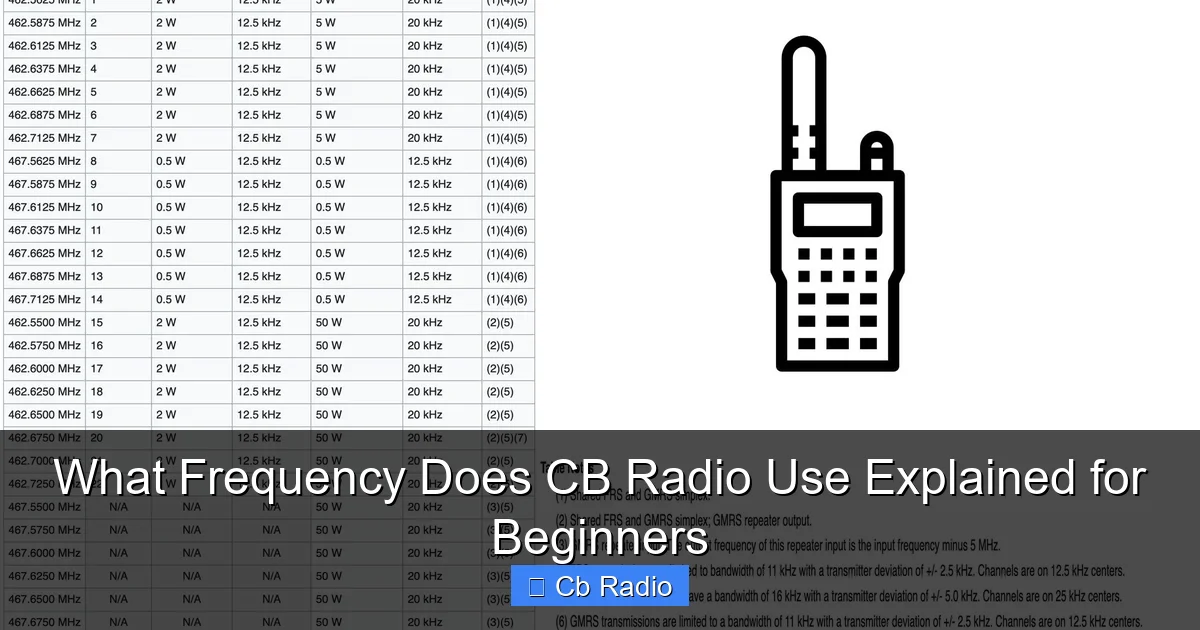
CB radios operate within the 27 MHz band, which falls under the High Frequency (HF) range of the radio spectrum. Specifically, CB radios use frequencies between 26.965 MHz and 27.405 MHz. This band is divided into 40 channels, each spaced 10 kHz apart.
Visual guide about What Frequency Does CB Radio Use Explained for Beginners
Image source: i.pinimg.com
Why 27 MHz?
The 27 MHz frequency was internationally designated for CB radio use because it offers a good balance between range and antenna size. At this frequency, antennas can be relatively small (compared to lower frequencies), and the signals can travel several miles under ideal conditions.
Channel Allocation
The 40 channels include frequencies like Channel 1 at 26.965 MHz, Channel 19 at 27.185 MHz, and Channel 40 at 27.405 MHz. Each channel corresponds to a specific frequency, and radios are tuned to these channels to transmit and receive signals. Knowing which channel corresponds to which frequency helps you communicate with others on the same channel.
Popular CB Radio Channels and Their Uses
Channel 19: The Truckers’ Channel
Channel 19 (27.185 MHz) is widely known as the trucker channel. It’s the go-to channel for truck drivers to communicate traffic updates, road hazards, and general chatter. If you’re traveling on highways, tuning into Channel 19 can keep you informed and connected.
Channel 9: Emergency Channel
Channel 9 (27.065 MHz) is designated as the emergency and roadside assistance channel. It’s reserved primarily for emergency communication and is monitored by some emergency services. It’s important to keep this channel clear unless you have a genuine emergency.
Other Channels and Their Common Uses
Channels 1-8 and 20-40 are often used for personal or local communication. Different groups may adopt specific channels for their conversations, but typically, these channels are open for anyone to use. Experimenting with different channels can help you find a clear frequency with less interference.
Transmission Modes on CB Radio Frequencies
AM (Amplitude Modulation)
Most CB radios use AM mode, which modulates the amplitude of the carrier frequency. This is the standard mode for CB communication and is compatible with all CB radios. AM signals have a limited range but are simple and effective for short-distance talking.
SSB (Single Side Band)
Some advanced CB radios support SSB mode. SSB transmits either the upper or lower sideband of the AM signal, which reduces bandwidth and power usage. This mode can extend the range of communication significantly, sometimes doubling or tripling it, depending on conditions.
FM and Other Modes
FM is generally not used on standard CB bands due to regulatory restrictions. However, some radios and users may operate on adjacent frequencies or other bands where FM is allowed, but this is outside the standard CB radio scope.
Practical Tips for Using CB Radio Frequencies Effectively
Choosing the Right Channel
Before transmitting, listen to a channel for a few moments to check if it’s busy. Avoid interrupting ongoing conversations. Use Channel 19 for traveling and general communication, but switch to other channels if it’s crowded.
Using SSB for Greater Range
If your radio supports SSB, try it out on less crowded channels like 36 or 38. SSB can help you reach users who are farther away, especially in rural or open areas.
Maintaining Proper Antenna Setup
Your antenna plays a crucial role in how well your CB radio performs on its frequencies. A properly tuned antenna matched to the 27 MHz band can improve range and clarity. Consider using a SWR meter to tune your antenna correctly.
Respecting CB Radio Etiquette
Always follow the rules: no profanity, no illegal use such as jamming or transmitting music, and keep conversations brief. This helps keep the airwaves clear and enjoyable for everyone.
The Legal Side of CB Radio Frequencies
No License Required in Many Countries
CB radios are license-free in many countries, including the United States, as long as users adhere to power limits (typically 4 watts for AM and 12 watts for SSB) and frequency restrictions. This makes CB radios accessible but also requires responsible use.
Power Limits and Frequency Restrictions
Staying within legal power limits ensures you don’t interfere with other services. Using frequencies outside the allocated CB range is illegal and can cause serious interference issues.
Cross-border Frequency Differences
While the 27 MHz band is standard for CB radios, some countries have slight variations in channel assignments or additional channels. Always check local regulations if you plan to use a CB radio abroad.
Conclusion
Understanding what frequency CB radio uses is the first step toward becoming an effective CB radio user. The 27 MHz band with its 40 channels provides a simple and accessible way for people to communicate over short distances. Whether you’re a traveler, a hobbyist, or someone who wants to stay connected in emergencies, knowing the frequencies and how to use them properly is essential.
Remember, the key channels like 19 and 9 have specific purposes, and experimenting with AM or SSB modes can enhance your communication experience. Keep your equipment tuned, respect radio etiquette, and enjoy the world of CB radio.
If you’re ready to get started, tune into Channel 19, say hello, and explore the possibilities of CB radio communication today!
Frequently Asked Questions
What does CB stand for in CB radio?
CB stands for Citizens Band. It is a radio service allowing citizens to communicate over short distances without a license.
Why is Channel 9 reserved for emergencies?
Channel 9 is designated for emergency use to ensure it remains open for people needing urgent assistance or roadside help.
What affects the range of CB radio frequencies?
The range depends on factors like terrain, antenna quality, power output, and atmospheric conditions.
Can CB radios communicate over long distances?
Typically, CB radios communicate over short to medium distances, usually a few miles, but SSB mode and favorable conditions can extend this.
Are all CB radio channels legal to use everywhere?
Most channels are legal for CB use, but some countries may have different channel allocations or restrictions, so check local laws.
What is the difference between AM and SSB on CB radios?
AM modulates the signal amplitude and is standard on CB radios, while SSB transmits only one sideband, improving range and clarity.