

Single Sideband (SSB) CB radio is a powerful feature that enhances communication by improving range and clarity over traditional CB radios. It allows users to transmit on a smaller bandwidth, reducing interference and increasing signal strength. Understanding SSB can elevate your CB radio experience, making it ideal for long-distance or professional use.
Contents
- 1 Key Takeaways
- 2 Quick Answers to Common Questions
- 3 📑 Table of Contents
- 4 Introduction
- 5 What is Single Sideband (SSB) in CB Radio?
- 6 Benefits of Using Single Sideband CB Radio
- 7 How to Use Single Sideband CB Radio
- 8 Who Should Consider Using SSB CB Radio?
- 9 Limitations and Considerations of SSB CB Radio
- 10 Tips for Getting the Most Out of Your SSB CB Radio
- 11 Conclusion
- 12 Frequently Asked Questions
- 13 Author
Key Takeaways
- What is SSB: A modulation method used in CB radios that transmits only one sideband, improving efficiency.
- Improved Range: SSB radios can communicate over longer distances compared to standard AM CB radios.
- Clearer Signals: Reduced noise and interference lead to better audio quality.
- Legal and Licensing: SSB CB radios operate within the same legal framework as regular CB radios but require compatible equipment.
- Practical Uses: Ideal for truckers, emergency communication, and hobbyists who need reliable long-range contact.
- Cost and Complexity: SSB radios are generally more expensive and slightly more complex to operate.
- Compatibility: SSB radios can communicate with standard CB radios but only in AM mode.
Quick Answers to Common Questions
What does SSB stand for in CB radio?
SSB stands for Single Sideband, a type of modulation used to improve signal efficiency and range in CB radios.
Can SSB CB radios talk to regular CB radios?
Yes, but only if the SSB radio switches to AM mode since regular CB radios typically don’t support SSB.
Is an SSB CB radio legal to use?
Yes, SSB CB radios are legal as long as they operate within FCC rules, including power limits and frequency bands.
Why is SSB better than AM for CB radios?
SSB uses less bandwidth and power, resulting in clearer audio and longer communication distances compared to AM.
Do I need a special license to use SSB CB radio?
No, SSB CB radios operate on the same channels as standard CB radios and don’t require a license for legal use.
📑 Table of Contents
Introduction
If you’ve ever explored the world of CB radios, you might have heard the term “Single Sideband” or SSB thrown around. But what exactly is single sideband CB radio, and why does it matter so much for users?
CB radios have been a staple for decades, providing a simple way to communicate over short to medium distances without a license. However, for those wanting clearer sound and longer reach, SSB technology is a game-changer. This article breaks down what single sideband CB radio is, how it works, and why it could be the right choice for your communication needs.
What is Single Sideband (SSB) in CB Radio?
The Basics of AM vs. SSB
Traditional CB radios use amplitude modulation (AM) to transmit signals. AM broadcasts the entire wave, including the carrier and two sidebands (upper and lower). This method is simple but inefficient because it wastes power transmitting redundant information.
Visual guide about What is Single Sideband CB Radio and Why It Matters for Users
Image source: thumbs.dreamstime.com
Single Sideband, on the other hand, cuts down on this redundancy. Instead of sending the carrier and both sidebands, SSB transmits only one sideband (either upper or lower). This makes the signal more efficient and focused.
How SSB Works
By eliminating the carrier and one sideband, SSB radios concentrate all their power into a single sideband. This results in a stronger, cleaner signal that travels further and resists interference better than AM signals.
SSB requires more precise tuning by the user, but the payoff is substantial, especially for long-distance communication.
Benefits of Using Single Sideband CB Radio
Extended Communication Range
The most notable advantage of SSB is its ability to reach greater distances. Because the signal is more powerful and focused, SSB users often find they can communicate hundreds of miles further than with standard AM CB radios.
This makes SSB especially popular among truckers and outdoor enthusiasts who need reliable communication over long distances.
Improved Audio Clarity
SSB reduces background noise and interference by transmitting a narrower bandwidth signal. The result is clearer conversations and less static, even in crowded radio environments.
Efficient Power Usage
Since SSB radios don’t waste energy transmitting the carrier and duplicate sideband, they use power more efficiently. This can translate into better battery life for portable radios and less strain on transmitters.
How to Use Single Sideband CB Radio
Choosing the Right Radio
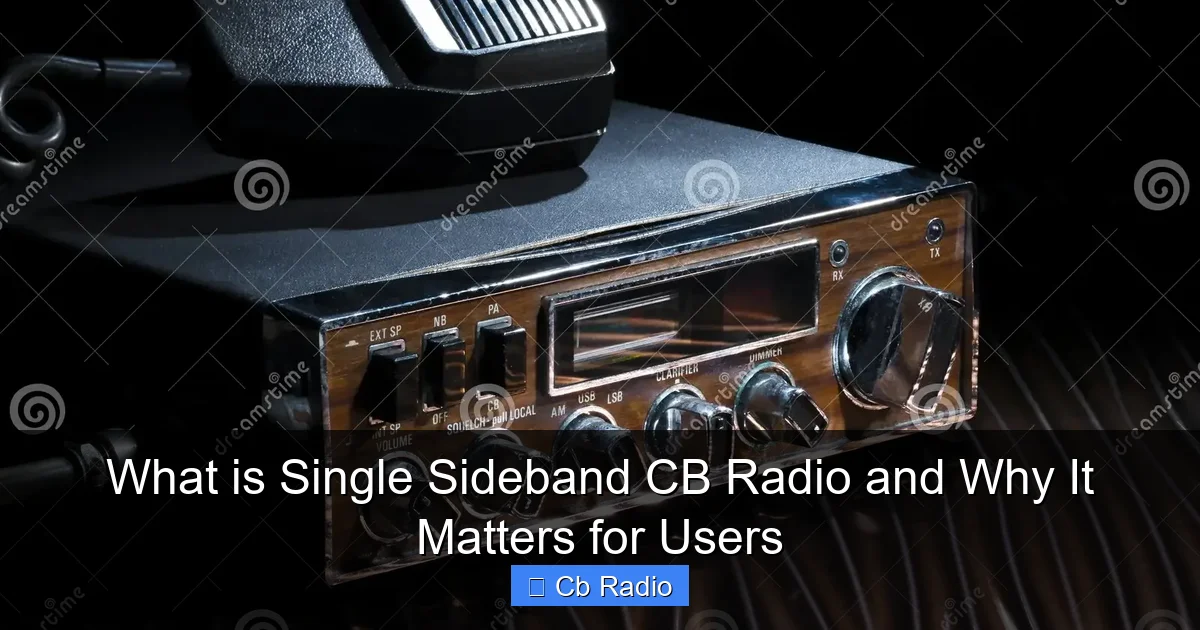
To benefit from SSB, you need a CB radio that supports the mode. Many modern CB radios come with SSB capability labeled as AM/SSB or just SSB.
When shopping, check for the ability to toggle between AM, USB (Upper Sideband), and LSB (Lower Sideband). Most CB users stick to LSB on channels below 20 and USB on channels above 20.
Tuning Your SSB Radio
SSB radios require fine-tuning to properly demodulate signals. Unlike AM radios, where the tuning is straightforward, SSB operators adjust the clarifier or fine-tuning knob to get clear audio.
It might take some practice, but once mastered, it’s easy to enjoy crystal-clear communications.
Communicating with Non-SSB Radios
SSB radios can still communicate with standard AM-only CB radios, but only in AM mode. If you want to reach users without SSB radios, switch your radio back to AM.
Who Should Consider Using SSB CB Radio?
Truck Drivers and Long-Haul Operators
Truckers rely on CB radios for traffic updates, emergencies, and general communication. The extended range and clarity of SSB make it ideal for those spending long hours on the road.
Outdoor Enthusiasts and Off-Roaders
For hikers, campers, and off-road drivers, SSB radios can provide reliable communication even when cell service is unavailable.
Emergency Preparedness
During disasters, when other communication networks fail, SSB CB radios can be a valuable tool for staying connected over longer distances.
Hobbyists and Radio Enthusiasts
Those who enjoy experimenting with radio technology appreciate the flexibility and performance SSB offers.
Limitations and Considerations of SSB CB Radio
Complexity for Beginners
SSB requires more knowledge and skill than standard AM CB radio. Beginners may find tuning and using SSB radios challenging at first.
Higher Cost
SSB-capable radios usually cost more than basic CB radios. If you only need short-range communication, the extra expense might not be worth it.
Legal Limits and Regulations
While SSB radios operate within CB frequency allocations, users must adhere to FCC rules, including power limits (typically 4 watts for SSB). Exceeding these can lead to fines or equipment confiscation.
Compatibility Issues
Since SSB and AM modes differ, communicating with users on different modes requires switching settings, which can be inconvenient during quick conversations.
Tips for Getting the Most Out of Your SSB CB Radio
- Practice tuning: Spend time getting familiar with the clarifier and fine-tuning controls.
- Use quality antennas: A good antenna improves signal strength dramatically.
- Monitor channels: Listen to active frequencies to understand how others use SSB.
- Keep power legal: Use the correct wattage to avoid interference and legal trouble.
- Join CB communities: Online forums and local clubs offer advice and support.
Conclusion
Single Sideband CB radio offers significant improvements over standard AM CB radios, especially in range and clarity. While it comes with slightly higher complexity and cost, the benefits make it worthwhile for many users. Whether you’re a truck driver, outdoor adventurer, or radio hobbyist, understanding what single sideband CB radio is and how to use it can greatly enhance your communication experience.
So, if you’re ready to take your CB radio conversations to the next level, consider exploring SSB technology. It might just be the upgrade you’ve been looking for.
Frequently Asked Questions
What is the difference between upper sideband (USB) and lower sideband (LSB)?
USB and LSB refer to the two types of single sidebands transmitted in SSB radios. USB is commonly used on higher channels (16-40), while LSB is typically used on lower channels (1-15). Both carry the same information but on different frequency ranges.
Can I use any antenna with an SSB CB radio?
While you can use most CB antennas, an antenna tuned specifically for SSB frequencies provides better performance and range. Many users upgrade to longer or higher-gain antennas to maximize SSB benefits.
Is it difficult to learn how to use an SSB CB radio?
There is a learning curve due to the need for fine-tuning and understanding sideband modes. However, with practice and patience, most users become comfortable using SSB radios.
Does SSB increase battery consumption on portable CB radios?
Not necessarily. SSB is more power-efficient in transmission, but some radios may use slightly more power due to additional circuitry. Overall, the difference is usually minimal.
Are there any popular brands that make SSB CB radios?
Yes, brands like Cobra, Uniden, and Midland produce popular SSB-capable CB radios known for reliability and good performance.
Can SSB CB radios be used for emergency communication?
Absolutely. Due to their longer range and clearer signals, SSB CB radios are excellent tools for emergency communication when other systems fail.