

SSB in CB radio stands for Single Sideband, a modulation type that boosts communication clarity and range. It allows users to transmit signals more efficiently, making it ideal for long-distance conversations and reducing interference. Understanding SSB can unlock better performance and reliability in your CB radio communications.
Contents
- 1 Key Takeaways
- 2 Quick Answers to Common Questions
- 3 📑 Table of Contents
- 4 Introduction to SSB in CB Radio
- 5 What is SSB in CB Radio?
- 6 Benefits of Using SSB in CB Radio
- 7 How to Use SSB on Your CB Radio
- 8 Limitations and Considerations of SSB Use
- 9 Real-Life Examples of SSB in CB Radio Use
- 10 Conclusion: Why SSB Matters for CB Radio Users
- 11 Frequently Asked Questions
- 12 Author
Key Takeaways
- What is SSB: Single Sideband is a type of amplitude modulation used in CB radios to improve signal quality.
- Improved Range: SSB allows longer communication distances than standard AM due to more efficient power usage.
- Better Clarity: SSB reduces background noise and interference, providing clearer audio.
- Frequency Efficiency: It uses less bandwidth, minimizing channel congestion.
- Equipment Needs: Using SSB requires compatible CB radios and sometimes additional tuning adjustments.
- Practical Uses: Ideal for truckers, hobbyists, and emergency communications where range and clarity matter.
- Legal Considerations: SSB use is regulated, so knowing local rules is important for legal operation.
Quick Answers to Common Questions
What does SSB stand for in CB radio?
SSB stands for Single Sideband, a type of modulation that improves signal efficiency and range in CB radio communication.
How does SSB improve CB radio communication?
SSB uses less bandwidth and power by transmitting only one sideband of the signal, resulting in clearer audio and longer transmission distances.
Can any CB radio use SSB?
No, only CB radios designed with SSB capability can transmit and receive in this mode.
What is the difference between LSB and USB in SSB?
LSB (Lower Sideband) and USB (Upper Sideband) are the two sidebands used in SSB; users typically choose one based on channel conventions to communicate effectively.
Is SSB legal to use on all CB channels?
SSB use is subject to local regulations, which may restrict its use to certain channels or power limits. Always check your area’s rules before using SSB.
📑 Table of Contents
Introduction to SSB in CB Radio
If you’ve ever dabbled in CB radio or even just heard about it, you might have come across the term “SSB.” But what exactly is SSB in CB radio? Why do some users swear by it while others stick to the standard AM mode? In simple terms, SSB stands for Single Sideband, a special type of modulation that can vastly improve your CB radio communication.
CB radio, or Citizens Band radio, has been a popular way for people to chat over short distances without needing a license. However, its standard mode—AM or Amplitude Modulation—has limitations like interference and limited range. SSB steps in as a powerful alternative, offering clearer sound and longer reach. Whether you’re a trucker, a radio hobbyist, or someone interested in emergency communication, knowing about SSB can change how you use your CB radio.
In this article, we’ll break down what SSB in CB radio means, how it works, and why it’s worth considering for your communication needs.
What is SSB in CB Radio?
Understanding Single Sideband Modulation
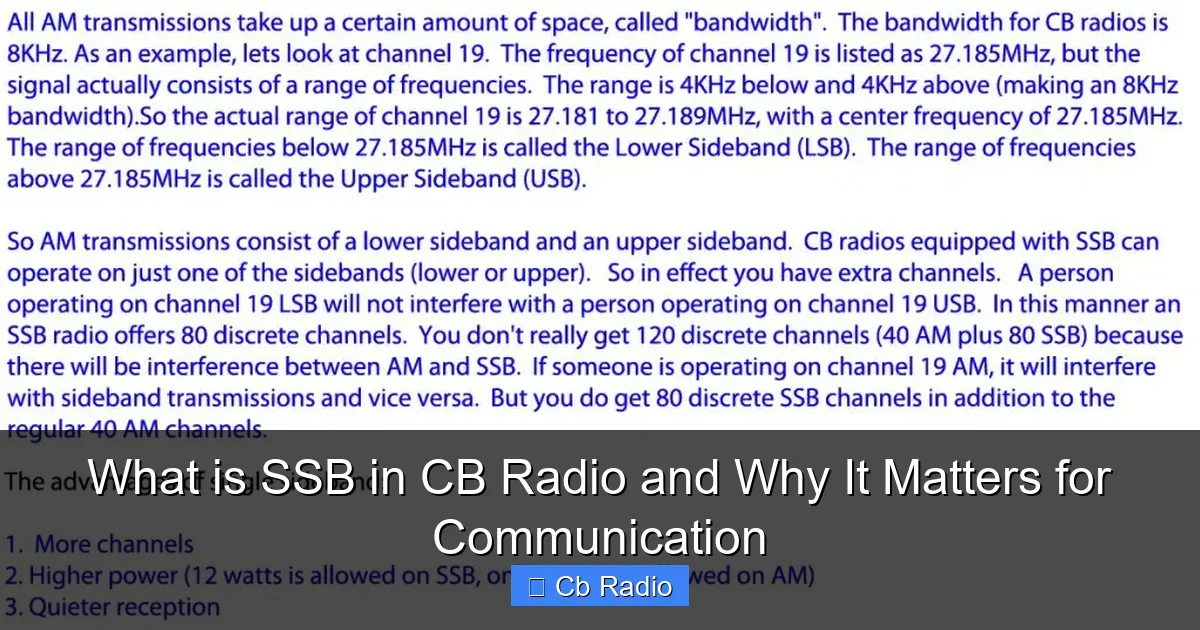
To grasp SSB, it helps to start with the basics of radio signals. Traditional CB radios use AM, where the carrier wave’s amplitude changes to carry voice information. This method sends the entire signal, including a carrier and two sidebands (upper and lower), which leads to wasted power and bandwidth.
Visual guide about What is SSB in CB Radio and Why It Matters for Communication
Image source: radiopicker.com
SSB, or Single Sideband, is a refined form of AM. Instead of transmitting the whole signal, it eliminates the carrier and one sideband, sending only one sideband containing the voice information. This means less power is wasted, and the signal is more focused.
How SSB Differs from AM
- Efficiency: SSB uses power more efficiently by transmitting only the essential part of the signal.
- Bandwidth: SSB occupies less bandwidth, reducing interference with nearby channels.
- Signal Strength: Because of the focused transmission, SSB signals can travel further.
Benefits of Using SSB in CB Radio
Extended Range for Longer Conversations
One of the biggest advantages of SSB is its extended range. With the same power output, an SSB transmission can travel much further than an AM signal. This is because SSB uses power more efficiently and focuses the signal, making it ideal for long-distance communication.
For example, truckers crossing vast highways use SSB to stay connected even when miles apart. Hikers and emergency responders also rely on SSB for its ability to maintain contact in remote areas.
Improved Audio Clarity and Reduced Noise
SSB reduces background static and interference, which can plague AM signals, especially in crowded urban environments or during bad weather. This results in clearer voice transmissions, making conversations easier to understand.
Since SSB cuts out the carrier and one sideband, there’s less noise, which means less distraction for listeners. This clarity is essential when precise communication is needed, such as in emergency situations.
Less Channel Congestion
Because SSB uses narrower bandwidth, it reduces the overlap between adjacent channels. This helps minimize congestion on popular CB frequencies, allowing more users to operate without interfering with each other.
How to Use SSB on Your CB Radio
Ensure Your Radio Supports SSB
Not all CB radios have SSB capability. If you want to use SSB, you’ll need a radio designed to support it. These radios often have a switch or setting labeled “AM/SSB” that lets you toggle between modes.
Select the Correct Sideband: LSB vs USB
SSB transmissions can be made on either the Lower Sideband (LSB) or Upper Sideband (USB). Most users stick to LSB on channels 1 through 15 and USB on channels 16 through 40. However, this is more of a convention than a strict rule.
Choosing the correct sideband helps ensure you can hear and be heard by others using SSB on the same channel.
Adjust Your Radio Properly
SSB requires manual tuning to get the best audio quality. This tuning is often done with a clarifier or fine-tuning knob that adjusts the receiver frequency slightly to match the incoming signal.
When transmitting, adjusting the microphone gain and using good quality microphones can also improve clarity.
Practical Tips for Using SSB
- Practice tuning your radio to get comfortable with the clarifier control.
- Use higher-gain antennas to maximize the range benefits of SSB.
- Communicate clearly and speak slowly to improve understanding over longer distances.
- Respect channel etiquette, especially on popular channels like 19 and 40.
Limitations and Considerations of SSB Use
Legal and Regulatory Aspects
While CB radio generally doesn’t require a license, SSB use is regulated differently in some countries. It’s important to check your local regulations before using SSB to ensure compliance with power limits and channel restrictions.
Learning Curve for New Users
SSB operation is a bit more complex than AM. New users may find the tuning and mode switching confusing at first. However, with practice, most find it manageable and rewarding.
Equipment Cost and Compatibility
SSB-capable radios tend to cost more than basic AM-only units. Also, not all CB radios can communicate directly with SSB radios unless they share the same mode and sideband.
Real-Life Examples of SSB in CB Radio Use
Truckers on the Road
Many long-haul truckers prefer SSB for cross-country communication. It allows them to maintain contact over hundreds of miles, receiving traffic updates, weather reports, and social communication.
Emergency and Disaster Response
In emergencies when cell towers fail, SSB CB radios can be a reliable backup for communication over long distances. Volunteer groups and first responders often use SSB to coordinate efforts.
Hobbyists and DXers
Radio enthusiasts who enjoy “DXing” (making long-distance contacts) use SSB to connect with other hobbyists far beyond normal CB range. SSB’s clearer audio and longer reach make it ideal for this purpose.
Conclusion: Why SSB Matters for CB Radio Users
SSB in CB radio is more than just a technical term—it’s an upgrade that can transform your communication experience. By offering longer range, clearer audio, and less interference, SSB makes CB radio more effective and enjoyable.
Whether you’re a professional driver, an emergency communicator, or a hobbyist, understanding and using SSB can open up new possibilities. While it requires a bit of learning and the right equipment, the benefits often outweigh the challenges.
So next time you pick up your CB radio, consider giving SSB a try. It might just be the key to better, farther-reaching conversations.
Frequently Asked Questions
Do I need a special license to use SSB on CB radio?
In most countries, CB radio operation does not require a license, including SSB use. However, some regions may have specific regulations, so it’s best to verify local laws.
Will an SSB radio work with a regular AM CB radio?
An SSB radio can receive AM transmissions, but AM radios cannot receive SSB transmissions. Communication requires both radios to be set to the same mode.
Why does SSB require tuning or a clarifier control?
Because SSB eliminates the carrier wave, the receiver must be finely tuned to decode the signal properly. The clarifier allows this precise adjustment for clear audio.
Is using SSB on CB radio more expensive?
SSB-capable radios generally cost more than basic AM models due to the added complexity. However, the benefits in performance often justify the price.
Can SSB help in emergency situations?
Yes, SSB’s longer range and clearer communication make it valuable for emergency and disaster scenarios when other communication systems fail.
What channels are best for SSB on CB radio?
Channels 1-15 typically use LSB, while channels 16-40 use USB. Channel 19 is popular among truckers using SSB, but always follow local conventions and etiquette.