

CB radio and GMRS are popular communication tools, but they serve different purposes and operate under different rules. While CB radio offers hassle-free, license-free communication mainly for short-range use, GMRS requires a license and provides extended range with better clarity. Understanding their differences helps you choose the right radio for your communication needs.
Contents
- 1 Key Takeaways
- 2 Quick Answers to Common Questions
- 3 📑 Table of Contents
- 4 What Is the Difference Between CB Radio and GMRS Explained
- 5 Understanding CB Radio
- 6 Exploring GMRS
- 7 Key Differences Between CB Radio and GMRS
- 8 Choosing Between CB Radio and GMRS
- 9 Tips for Getting the Most Out of Your Radio
- 10 Conclusion
- 11 Frequently Asked Questions
- 12 Author
Key Takeaways
- Frequency Bands: CB radios use 27 MHz, while GMRS operates on UHF frequencies around 462 and 467 MHz.
- Licensing Requirements: CB radios require no license; GMRS users must obtain an FCC license.
- Range Differences: GMRS generally offers longer range, often several miles, compared to CB’s typical 1-5 miles.
- Power Output: GMRS radios can legally transmit up to 50 watts, whereas CB radios are limited to 4 watts.
- Usage Scenarios: CB radios are popular with truckers and casual users; GMRS suits families, outdoor enthusiasts, and small business communications.
- Equipment Types: GMRS radios often include handheld walkie-talkies and mobile units, while CB radios are commonly base or mobile units.
- Interference and Clarity: GMRS tends to have clearer audio and less interference due to higher frequencies and better signal penetration.
Quick Answers to Common Questions
What frequency bands do CB and GMRS use?
CB radios operate on 27 MHz (HF band), while GMRS radios use UHF frequencies around 462 and 467 MHz.
Do I need a license to use CB or GMRS?
CB radio does not require a license, but GMRS users must obtain an FCC license to operate legally.
Which radio offers longer communication range?
GMRS radios generally provide longer range—up to 20 miles—whereas CB radios typically reach 1-5 miles.
Can I use handheld radios for both CB and GMRS?
Handheld radios are common for GMRS but rare for CB, which mostly uses mobile or base units.
Which radio is better for urban environments?
GMRS is usually better in urban areas due to its higher frequency and better signal penetration.
📑 Table of Contents
What Is the Difference Between CB Radio and GMRS Explained
If you’re looking into radio communication options, chances are you’ve come across CB radio and GMRS. Both are popular choices for personal and small group communication, but they are quite different in how they operate, their range, licensing requirements, and best use cases. Understanding these differences can save you time and money, helping you choose the right tool for your communication needs.
CB radio has been around for decades, especially popular among truckers and hobbyists. GMRS, or General Mobile Radio Service, is a more recent option that offers some distinct advantages but comes with licensing and equipment requirements. In this article, we’ll break down what sets CB radio and GMRS apart so you can make an informed choice.
Understanding CB Radio
What Is CB Radio?
CB stands for Citizen’s Band radio. It’s a short-distance radio communication system that anyone can use without a license. Operating on the 27 MHz frequency band, CB radios offer 40 channels for users to communicate. They’re commonly used by truck drivers, off-roaders, and people who want a simple way to chat over short distances.
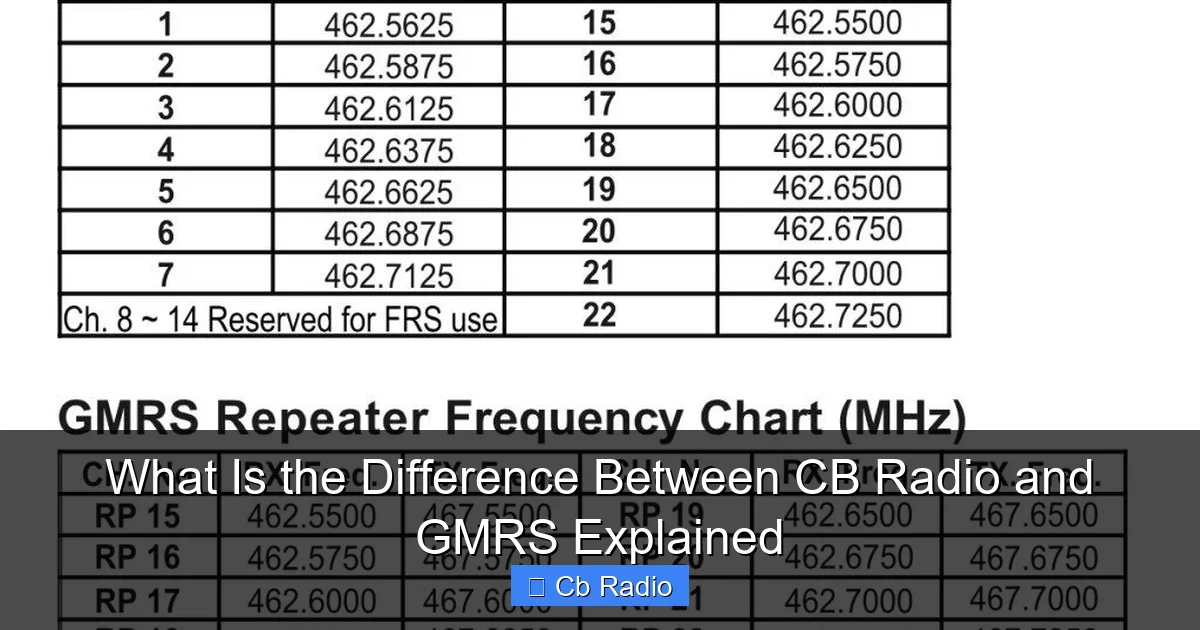
Visual guide about What Is the Difference Between CB Radio and GMRS Explained
Image source: i.pinimg.com
Features and Limitations
One of the biggest advantages of CB radio is that it’s license-free. You can buy a CB radio at a low cost and start communicating right away. Power output is limited to 4 watts, which restricts the typical communication range to 1-5 miles, depending on terrain and conditions. CB radios are also prone to interference and static, especially in urban areas or during bad weather.
Practical Uses of CB Radio
CB radios are great for casual communication on highways, during road trips, or at work sites. Truck drivers use them to share traffic updates and road conditions. Off-road enthusiasts rely on CB radios for group coordination. Because they don’t require any license or special setup, CB radios remain a popular choice for quick and easy communication.
Exploring GMRS
What Is GMRS?
GMRS stands for General Mobile Radio Service. It operates on UHF frequencies around 462 and 467 MHz and is designed for short- to medium-range communication. Unlike CB radios, GMRS users must obtain an FCC license, which is relatively easy and inexpensive to get. GMRS radios can transmit with power levels up to 50 watts, significantly boosting their range compared to CB radios.
Licensing and Regulations
To legally operate a GMRS radio, you need an FCC license, which covers your entire family. This requirement ensures that users follow proper protocols and helps reduce interference. The license process is straightforward, involving an online application and a fee, with no exam required. This licensing difference is a key factor that separates GMRS from CB radio.
Equipment and Range
GMRS radios come in handheld units (walkie-talkies), mobile radios for vehicles, and base stations. Thanks to higher power and UHF frequencies, GMRS radios generally provide clearer audio and better penetration through buildings and forests. Typical communication range is 2-5 miles for handhelds and up to 20 miles or more with mobile or base units and proper antennas.
Key Differences Between CB Radio and GMRS
Frequency and Signal Characteristics
CB radios use lower 27 MHz frequencies (HF band), which can travel farther under ideal conditions but are more susceptible to interference and noise. GMRS uses UHF frequencies (around 462-467 MHz), which tend to provide more reliable, clearer audio over shorter distances, especially in urban or wooded areas.
Power Limits and Range
CB radios max out at 4 watts, limiting their range. GMRS radios can legally transmit up to 50 watts, offering significantly longer communication distances. This makes GMRS ideal for scenarios where you need dependable communication over several miles.
Licensing and Legal Use
CB radio is license-free and open for anyone to use, which makes it accessible but sometimes crowded or noisy. GMRS requires a license, meaning fewer users and less interference. This licensing also ensures users follow proper operating procedures.
Typical Applications
CB radios are often used by truckers, off-road drivers, and hobbyists who want basic communication without any hassle. GMRS is preferred by families, outdoor enthusiasts, and small businesses needing reliable, private communication over longer distances.
Choosing Between CB Radio and GMRS
Consider Your Communication Needs
Ask yourself: How far do you need to communicate? If you want short-range communication without licensing fuss, CB could be enough. If you need longer range, clearer audio, and are willing to get a license, GMRS is the better choice.
Evaluate the Environment
Urban and forested areas can block radio signals. GMRS’s UHF frequencies generally perform better in these conditions. CB radio signals may travel farther in open spaces but suffer more interference in built-up areas.
Budget and Equipment Choices
CB radios are less expensive and widely available. GMRS radios can cost more but often come with better features like privacy codes, group calling, and higher power. Factor in the cost of licensing for GMRS as well.
Tips for Getting the Most Out of Your Radio
Use Quality Antennas
Whether you choose CB or GMRS, a good antenna can dramatically improve your range and clarity. Consider investing in a high-quality external antenna if you plan to use mobile or base station radios.
Follow Proper Channel Etiquette
Respect others using the same channels. Avoid profanity and keep conversations brief to allow everyone a chance to communicate.
Maintain Your Equipment
Regularly check your radio and antenna connections. Keep batteries charged and spare batteries handy if using handheld units.
Conclusion
CB radio and GMRS both offer valuable communication options, but they serve different needs. CB radio is simple, license-free, and ideal for casual, short-range chats. GMRS requires a license but provides longer range, clearer audio, and more power—perfect for families, outdoor adventures, and small businesses. By understanding these differences, you can pick the radio that fits your lifestyle and communication goals best.
Whether you’re a weekend off-roader, a family preparing for emergencies, or a small business owner, knowing the difference between CB radio and GMRS ensures you get the right tool for the job. Happy communicating!
Frequently Asked Questions
Is GMRS better than CB radio?
GMRS offers longer range, better audio clarity, and more power than CB radio but requires a license. Whether it’s better depends on your specific needs and willingness to comply with licensing rules.
Can I talk to people on CB and GMRS radios at the same time?
No, CB and GMRS operate on different frequencies and are not compatible, so you cannot communicate between the two systems directly.
How much does a GMRS license cost?
An FCC GMRS license currently costs around $35 and is valid for 10 years. It covers you and your immediate family members.
Are there privacy features on CB or GMRS radios?
GMRS radios often include privacy codes and channels to reduce interference. CB radios typically do not have privacy features and are open for anyone to listen.
Can GMRS radios be used for emergency communication?
Yes, GMRS radios are commonly used for emergency and family communication due to their longer range and clearer signals.
What is the typical range of a CB radio in open terrain?
In open terrain, a CB radio can reach up to 5 miles or slightly more, depending on terrain and antenna quality.