

CB radio and ham radio are two popular communication systems, each with unique features and purposes. While CB radios are easy to use and great for short-range communication, ham radios offer more flexibility, longer range, and require licensing. This guide breaks down the main differences to help you choose the right one.
Contents
- 1 Key Takeaways
- 2 Quick Answers to Common Questions
- 3 📑 Table of Contents
- 4 Introduction
- 5 What Is CB Radio?
- 6 What Is Ham Radio?
- 7 Key Technical Differences Between CB and Ham Radio
- 8 Licensing and Legal Considerations
- 9 Range and Communication Capabilities
- 10 Community, Uses, and Practical Tips
- 11 Conclusion
- 12 Frequently Asked Questions
- 13 Author
Key Takeaways
- Purpose: CB radios are mostly for casual, short-distance communication; ham radios support hobbyists and emergency communication with broader capabilities.
- Licensing: CB radios require no license; ham radios need an FCC license for legal operation.
- Frequency Range: CB radios operate on 40 channels around 27 MHz; ham radios cover a wide range of frequencies from HF to UHF bands.
- Range: CB radios generally have a range of a few miles; ham radios can communicate across states and even worldwide.
- Equipment and Cost: CB radios are affordable and simple; ham radios vary widely in complexity and price depending on features.
- Community and Uses: Ham radio has a large, active community focused on technical skills and emergency services; CB radio is popular among drivers and local communities.
Quick Answers to Common Questions
What is the main difference between CB radio and ham radio?
CB radio is license-free and used for short-range communication, while ham radio requires a license and supports long-distance, versatile communication.
Do I need a license to operate a CB radio?
No, CB radios can be used without a license in the United States.
How far can CB radio signals travel?
Typically, CB radio signals travel 1 to 5 miles depending on conditions like terrain and antenna quality.
What types of communication modes do ham radios support?
Ham radios support voice, Morse code, digital modes, and more, offering a wide range of communication options.
Can ham radio be used during emergencies?
Yes, ham radio is widely used for emergency communications when other systems fail.
📑 Table of Contents
Introduction
If you’ve ever wondered about the difference between CB radio and ham radio, you’re not alone. Both are forms of two-way radio communication, but they serve different users and purposes. Whether you’re a trucker chatting with fellow drivers or a radio hobbyist experimenting with long-distance communication, knowing how these systems differ can help you pick the right one for your needs.
In this article, we’ll explore what makes CB radio and ham radio unique. We’ll dive into their history, technical details, licensing requirements, and common uses. By the end, you’ll have a clear understanding of how these radios work and which might be right for you.
What Is CB Radio?
Overview of CB Radio
CB stands for “Citizens Band” radio. It is a short-distance communication system that anyone can use without a license. Introduced in the 1940s, CB radio became hugely popular in the 1970s, especially among truck drivers and road travelers.
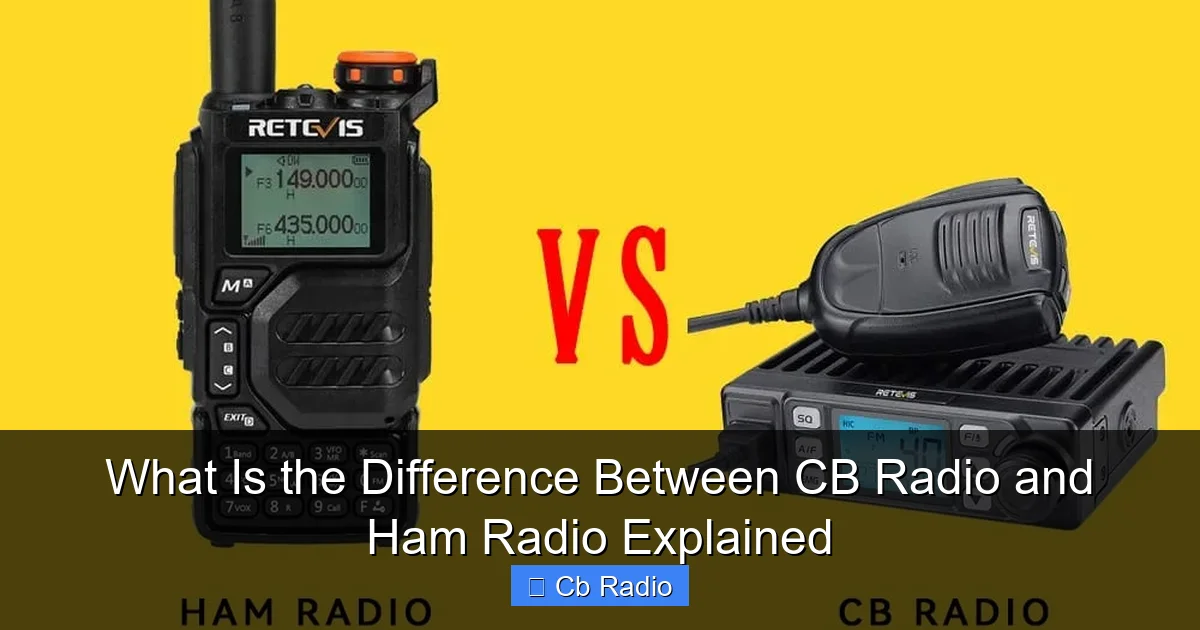
Visual guide about What Is the Difference Between CB Radio and Ham Radio Explained
Image source: twowayradiocommunity.com
How CB Radio Works
CB radios operate on 40 channels within the 27 MHz (megahertz) band. They typically use amplitude modulation (AM) or single sideband (SSB) for voice transmission. CB radios have limited power, usually capped at 4 watts for AM and 12 watts for SSB, which restricts their range to a few miles under normal conditions.
Typical Uses for CB Radio
CB radios are great for local communication. Truckers use them to share road conditions, directions, and warnings. Off-roaders and hobbyists also use CB to stay connected over short distances. The no-license requirement and simple operation make CB radios very accessible.
What Is Ham Radio?
Overview of Ham Radio
Ham radio, also called amateur radio, is a hobby and service that allows licensed operators to communicate over various frequencies worldwide. It’s older than CB radio and provides much more flexibility and capabilities for users who want to experiment with radio technology, support emergency communications, or just connect with others globally.
How Ham Radio Works
Ham radios operate across a wide spectrum of frequencies, from very low frequencies (VLF) to ultra-high frequencies (UHF) and beyond. Operators can use different modes, including AM, FM, single sideband (SSB), Morse code, digital modes, and more. Power levels vary but can be much higher than CB radios, allowing communication over hundreds or thousands of miles.
Licensing and Regulations
Unlike CB radios, ham radios require users to pass an exam and obtain a license from the FCC in the U.S. Licensing ensures operators understand radio theory, regulations, and proper operating procedures. There are different license classes with increasing privileges.
Key Technical Differences Between CB and Ham Radio
Frequency Bands
CB radios operate strictly on 27 MHz with 40 fixed channels. Ham radios can use multiple bands, including HF (1.8 to 30 MHz), VHF (30 to 300 MHz), and UHF (300 MHz to 3 GHz). This wide range allows ham operators to choose bands based on distance, time of day, and atmospheric conditions.
Power Output
CB radios are limited to 4 watts AM and 12 watts SSB, which limits communication range. Ham radios can legally transmit up to 1500 watts depending on license and equipment, greatly extending their reach.
Modes of Communication
CB radios mainly use AM and SSB voice modes. Ham radios support many modes including voice, Morse code (CW), digital modes like FT8, and packet radio, allowing diverse communication methods.
Licensing and Legal Considerations
CB Radio Licensing
No license or exam is needed to operate a CB radio in the U.S. However, operators must comply with FCC rules such as power limits and channel use. This ease of access makes CB popular for everyday users.
Ham Radio Licensing
Ham radio operators must pass a test covering radio theory, regulations, and operating practices. There are three license classes—Technician, General, and Amateur Extra—each granting different operating privileges. Licensing promotes responsible use and technical competence.
Range and Communication Capabilities
CB Radio Range
Typical CB radio range is 1 to 5 miles under normal conditions. Terrain, antenna quality, and weather can affect this. CB is best for local conversations.
Ham Radio Range
Ham radio can reach anywhere from a few miles to worldwide. HF bands support long-distance (DX) communication by bouncing signals off the ionosphere. VHF/UHF bands are ideal for local or regional use, including satellite contacts.
Community, Uses, and Practical Tips
Who Uses CB Radio?
CB radios are favored by truck drivers, off-road enthusiasts, and casual users who want simple short-range communication. They’re easy to install in vehicles and use on the go.
Who Uses Ham Radio?
Ham radio attracts hobbyists, emergency responders, and tech enthusiasts. It’s also valuable during disasters when other communication fails. Many hams enjoy building equipment, contesting, and connecting worldwide.
Practical Tips for Choosing Between CB and Ham Radio
- Consider your communication needs: For casual, local chats, CB radio is simple and effective.
- Think about range and flexibility: For longer range and diverse modes, ham radio is better.
- Prepare for licensing: If you want to get into ham radio, be ready for the licensing process.
- Invest in proper equipment: CB radios are cheaper; ham radios can be a bigger investment but offer more features.
- Engage with communities: Local clubs and online forums can help you learn and get started with either radio type.
Conclusion
Both CB radio and ham radio have their unique strengths and ideal uses. CB radio offers an easy, license-free way to communicate locally and is perfect for drivers and casual users. Ham radio, on the other hand, is a more advanced hobby that opens the door to global communication, technical learning, and emergency service. Understanding the differences between these two radios helps you decide which one fits your lifestyle and communication goals best.
Whether you want simple, instant chat on the road or to dive into the exciting world of amateur radio, both CB and ham radios have a place in today’s connected world.
Frequently Asked Questions
Is CB radio still relevant today?
Yes, CB radio remains popular among truckers and local communities for quick, short-range communication without the need for licensing.
How difficult is it to get a ham radio license?
Getting a ham radio license requires studying and passing an exam, but many find it manageable with available resources and classes.
Can CB radios communicate with ham radios?
No, CB radios and ham radios operate on different frequencies and cannot directly communicate with each other.
What equipment do I need to start with ham radio?
You need a ham radio transceiver, an antenna, and a license. Many beginners start with handheld radios to learn the basics.
Are there any restrictions on CB radio use?
Yes, users must follow FCC rules such as power limits, channel usage, and avoiding interference with other communications.
What are common uses of ham radio besides chatting?
Ham radio is used for emergency communication, technical experimentation, satellite communication, and public service events.